A habit is a behavioral pattern that forms automatically or mechanically whenever an individual repeats an action over time. Whether an action is performed with full conscious intent or without thinking, repeating it at specific intervals causes it to crystallize into a habit. Habits generally fall into two categories: good habits and bad habits.
While building and maintaining good habits often feels like an uphill battle, bad habits seem to take over effortlessly. Behind this asymmetry lies the evolutionary wiring of the human brain and fundamental principles of behavioral psychology.
1. Immediate Reward vs. Delayed Gratification
Evolutionarily, the human brain was designed to prioritize immediate relief and short-term gains.
- Bad Habits: The reward loop for a bad habit is instant. When you eat junk food or scroll endlessly on social media, your brain experiences an immediate surge of dopamine, delivering instant gratification and comfort. However, the negative consequences—such as health deterioration or wasted time—only manifest months or years down the road.
- Good Habits: Good habits operate in reverse. Performing the action often requires immediate effort, discomfort, or willpower, while the true benefits—such as robust health or financial growth—are heavily delayed.
2. Why Our Best Intentions Fail
A vast majority of human decisions occur without our conscious awareness. Waking up and immediately reaching for your phone, brushing your teeth, or brewing morning coffee are executed automatically by the brain.
We often witness people loudly proclaiming, “I am going to change my life!” only to fall back into their old routines within a few days. Reflect on your own experience—how many new habits have you started with high enthusiasm, only to abandon them shortly after?
In these moments, we tend to blame ourselves: “I lack willpower; I lack discipline; I just can’t stick to things like other people do.
“However, science reveals a different reality: You are not failing due to personal weakness, but because you are expecting rapid results from a process that inherently takes time. Modern humans crave instant results and struggle with patience.
3. The Motivation Trap and Ego Depletion
Most people believe that building a new habit simply requires motivation or sheer willpower. In reality, motivation is merely a fleeting emotional state. While motivation or ambitious goals can help initiate an action, once a behavior becomes a habit, conscious goal-seeking plays a minimal role.
According to the Ego Depletion Theory, self-control functions like a muscle. As you navigate work, make decisions, and manage emotional stress throughout the day, this mental energy drains. By evening, your capacity for self-regulation is largely exhausted. This explains why someone who meticulously adheres to a healthy diet all day might binge on junk food at night.
Key Takeaway: Never rely solely on willpower to build new habits. Instead, design an environment that supports your desired behaviors even when your brain’s self-control capacity is depleted.
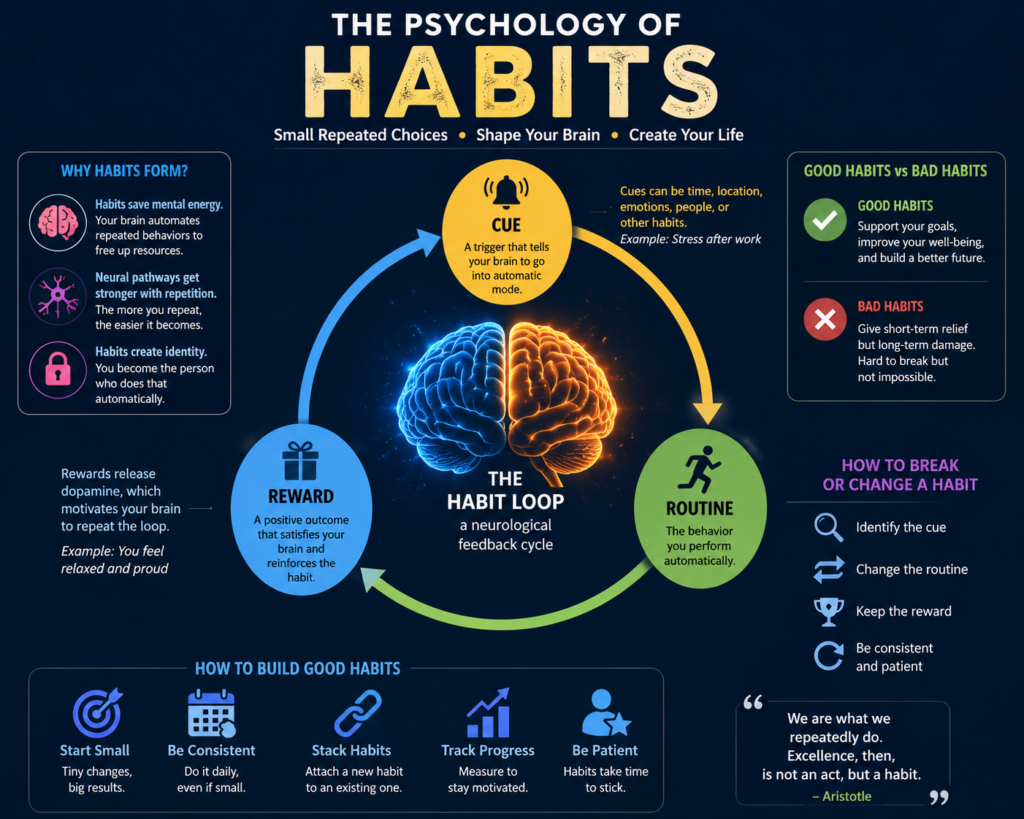
4. The Neurological Habit Loop
Research shows that every habit moves through a four-step neurological loop:
- Cue: The trigger that signals the brain to initiate a behavior (a specific time, location, emotional state, presence of a person, or preceding action).
- Craving: The anticipation of the change in state that the action will bring.
- Routine: The actual behavior or action performed.
- Reward: the satisfaction or relief the brain receives from completing the routine.
As a habit becomes ingrained, dopamine—the brain’s reward chemical—is no longer released only when you receive the reward; it begins firing the moment you encounter the cue. This neurological shift is what creates powerful cravings.
Completely erasing a bad habit is extremely difficult. The effective strategy is to keep the original cue and reward, but swap out the underlying routine.
5. The Timeline: The 66-Day Reality
The belief that it takes “21 days to form a habit” is a widespread myth.
- On average, it takes approximately 66 days for a new behavior to become automatic.
- Depending on the individual’s personality and the complexity of the behavior, this timeline can range anywhere from 18 to 254 days.
Missing a single day during this process will not derail your long-term habit formation. Therefore, if you slip up once, do not assume all progress is lost and give up. Habit building is not achieved through perfection, but through continuous repetition.
6. Implementation Intentions (If-Then Planning)
Studies suggest that people who simply state, “I will do X,” fail up to 53% of the time. When the time comes to act, the mind gets distracted or succumbs to friction. A scientifically validated solution to this is Implementation Intentions, or If-Then Planning:
If Situation Y occurs, THEN I will perform Action Z
- Example: Instead of saying, “I will exercise tomorrow,” define it specifically: “IF it is 7:00 AM (Situation Y), THEN I will put on my running shoes and walk for 10 minutes (Action Z).”
This removes the cognitive burden of decision-making in the moment, prompting the brain to execute the action automatically when the trigger occurs.
7. Habit Stacking and Environmental Design
Although humans worry about the future, we rarely act in its best interest naturally. The brain consistently values immediate, smaller rewards (e.g., eating sweets) over delayed, larger returns (e.g., long-term health). To bypass this bias, use two techniques:
1.Habit Stacking: Anchor a new habit onto an established one.
- Example: “After I pour my morning coffee (established habit), I will read a book for two minutes (new habit).”
2. Environmental Design: Instead of fighting bad habits with willpower, remove their cues from your environment. Decrease friction for good habits (make them easy to start) and increase friction for bad ones (make them hard to access).
8. Identity Shift: Who Do You Want to Become?
We constantly measure our current actions against our ultimate goals. However, true, lasting behavioral change does not happen by focusing solely on outcomes; it happens by focusing on an Identity Shift
- The goal should not be to read a book; it should be to become a reader.
- The goal should not be to run a marathon; it should be to become a runner.
Every small action you take serves as a vote for the type of person you wish to become. Reading for two minutes a day is not just a brief task—it is concrete evidence to your brain that “I am a reader.”
The 7-Step Habit Blueprint
- Stop Relying on Motivation: Build systems that function even when your willpower is depleted.
- Map Your Habit Loop: Identify your specific cues, cravings, routines, and rewards.
- Start Small: Scale down new habits so they take two minutes or less to perform.
- Be Patient: Accept the reality that automaticity takes an average of 66 days.
- Use If-Then Plans: Pre-determine your actions to eliminate decision fatigue.
- Leverage Habit Stacking: Pair new behaviors directly with existing daily routines.
- Shift Your Identity: Use small, daily actions to cast votes for your new self.
📌 To explore further, access the free resource: https://societalechoes.com/7-day-habit-mastery-course-the-system-over-motivation-framework/
Building lasting habits is not an overnight miracle. It is the compound interest of small, consistent daily actions. Focus on designing systems that support your growth, and guard your environment carefully against negative routines.