
What is money? How has it transformed human society throughout history? Why do some people always stay ahead financially while others fall into debt traps?
Many people claim that money is evil and that running after it will ruin your life. On the other hand, some tie money directly to human worth—believing that you need money in your hands to earn respect even within your own family, respect in society, or to get married.
Those who think all of this is entirely wrong are often either averse to hard work or incapable of managing the income they earn. You cannot solve every problem in your life using money, but you can resolve a vast majority of them. Running a household or a family requires a steady income. Until a certain point, you live off your parents, but eventually, you must ensure their needs are met. Getting married isn’t enough; you must also provide for your partner and children, which requires income. If illness strikes, you need money for healthcare. Financial education is one of the most vital subjects you must learn in life. If you can live comfortably within your earned income rather than trying to impress others, life can feel like paradise.
Let us examine the secrets of money and the pathways to financial independence, drawing from the insights and treatises of renowned economists and thinkers.
1. What is Money?
Money is a tool created by humans to simplify exchange. Generally, we refer only to notes and coins as money. However, studies show that money is neither just a piece of paper nor a lump of metal; it is a symbol of mutual trust between human beings. Any object that is universally accepted within a society can serve as money. Today, the central banks of respective countries make decisions regarding money.
Three Primary Functions of Money:
- Medium of Exchange: Helps facilitate the buying and selling of goods and services.
- Store of Value: Allows the fruits of today’s labor to be stored and used in the future.
- Unit of Account: Acts as a standard measure to evaluate the worth of all items.
2. The History and Evolution of Money
When discussing the evolution of money, we typically think of the ‘barter system‘ (trading goods for goods). However, David Graeber challenges this assumption in his famous book, Debt: The First 5000 Years.
The true evolutionary timeline of money is as follows:
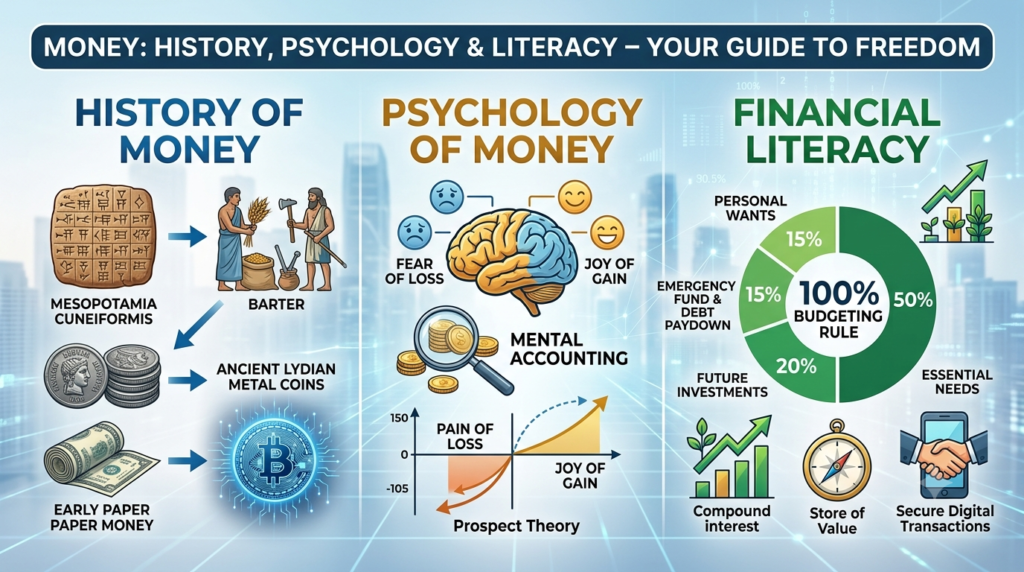
Debt/Credit System ➔ Barter/Cowrie Shells ➔ Coins (Lydia) ➔ Paper Money ➔ Digital & Crypto (Bitcoin)
Key Milestones in History:
- Debt and Accounting Ledgers: Even before the barter system, human societies in ancient Mesopotamia operated largely through the concept of ‘debt’. People recorded mutual obligations on clay tablets.
- The World’s First Official Currency System: In the 7th century BC, in the kingdom of Lydia (modern-day Turkey), the world’s first official metal coins were minted. They were made of ‘electrum‘, a natural alloy of gold and silver.
- China and Paper Money: Paper money was first widely used in China during the 10th century.
- The Digital Era and Bitcoin: Physical money evolved into digital entries and eventually into decentralized currencies.
3. The Psychology of Money
Human financial decisions are not entirely rational; they are deeply tied to human emotions. This is precisely why financial distress sometimes drives people to make tragic choices.
- Mental Accounting: People mentally compartmentalize the same amount of money into different categories based on its origin. For instance, a person who hesitates to spend 1,000 rupees earned through hard work might recklessly blow 1,000 rupees won in a lottery or received as a bonus. In reality, every rupee holds the exact same value.
- Prospect Theory: Human beings experience twice the psychological pain from a loss as they do pleasure from an equivalent gain. This is why many people avoid viable investments out of a fear of risk.
4. Financial Literacy and Avoiding Debt
Financial illiteracy is what pushes the majority of people into poverty and debt traps. People fall into debt when their expenses exceed their income. Just a tiny leak is enough to sink a massive ship!
A person who seeks advice on every minor matter will rarely consult someone knowledgeable about financial matters or attempt to educate themselves on the subject.
Remember: The key isn’t how high your income is, but how skillfully you manage that income.
Good Debt vs. Bad Debt
Many people fall into debt traps simply because they cannot distinguish between good debt and bad debt. Rising personal debt drags down not just individuals, but an entire nation’s economy.
| Factor | Good Debt | Bad Debt |
| Purpose | Taken to build assets or boost future income. | Taken for consumable goods or temporary luxuries. |
| Examples | Education loans, business loans, value-appreciating real estate. | Credit card dues, luxury car loans, gadget EMIs. |
| Financial Outcome | Empowers you with greater financial capacity in the future. | Siphons away your future income. |
5. How the Wealthy Make Money Work for Them
Wealthy individuals do not just trade their time and labor for money; they put their money to work.
- The Power of Compounding: The phenomenon where you earn interest on interest. Starting investments early allows you to harness the full power of compounding.
- Buying Assets Instead of Liabilities:
- Assets: Things that put money into your pocket (e.g., rental real estate, stocks, mutual funds).
- Liabilities: Items requiring heavy maintenance or luxury goods that drain money out of your pocket.
6. Various Investment Avenues
Never keep your money idle; ensure proper diversification. You can invest money across various channels depending on your goals and risk tolerance:
- Equities and Stocks: Buying shares of companies offers the potential for high long-term returns (12%–15%), though you must be prepared to weather market volatility.
- Mutual Funds: Invest small amounts systematically every month (SIP) managed by professional fund managers.
- Real Estate: Investments in land and buildings. Ideal for steady rental income and capital appreciation.
- Gold: Acts as a safe haven during economic downturns and helps hedge against inflation.
- Fixed Deposits and Bonds: Low-risk, stable-return options (Bank FDs, Government Bonds).
7. Inflation: The Silent Enemy of Wealth
Any discussion on money is incomplete without addressing inflation.
- Concept: What you can buy today for 100 rupees cannot be bought for the same 100 rupees 10 years from now. The erosion of purchasing power over time is called inflation.
- If money sits idle in a bank account, its value shrinks due to inflation. This is why financial experts advise choosing investment vehicles that generate returns higher than the inflation rate (e.g., 6%–7%).
8. Tax Planning and Risk Management
- Tax Planning: Alongside wealth generation, minimizing taxes legally is crucial. Channeling a portion of your savings into tax-saving instruments helps retain more money for your future.
- Risk Management and Insurance: No matter how well you invest, an unforeseen emergency (like severe illness) can wipe out your entire savings. The foundation of a financial pyramid consists of health insurance and term life insurance to protect your family. Insurance is not an investment; it is a shield protecting your savings.
9. Financial Scams and Security in the Digital Age
In today’s era, cybersecurity is an essential component of financial security. While digital transactions have made financial dealings fast and convenient, the risk of fraud has escalated proportionately.
People are frequently duped out of their money through phishing, fake links, OTP scams, and fraudulent apps.
- Never share personal information with anyone.
- Avoid suspicious links.
- Use strong passwords and enable two-factor authentication (2FA).
Navigating this digital world safely requires a blend of vigilance and technological awareness.
10. How to Allocate Your Income (The 100% Budgeting Rule)
A universally recommended rule by financial experts worldwide is the 100% budgeting framework. Take your total monthly income as 100% and divide it cleanly into four parts:
- 50% — Essential Needs: Half your income goes toward non-negotiable living expenses.
- House rent / Mortgage
- Groceries and food
- Electricity, water, and internet bills
- Health and life insurance premiums
- Children’s education and commuting costs
20% — Investments & Wealth Creation: This 20% puts your money to work for you. Apply the principle: “Don’t save what is left after spending; instead, spend what is left after saving.
- “Stock market, mutual funds (SIP / Index Funds)
- Retirement accounts (Pension funds)
- Real estate, sovereign gold bonds
15% — Emergency Fund & Debt Repayment: This is the shield that ensures your financial safety.
- Build an emergency fund covering at least 3 to 6 months of living expenses.
- Use excess funds here to pay off credit card balances or personal loans swiftly.
15% — Wants & Personal Lifestyle: Use this money to enjoy life and nurture mental well-being.
- Movie outings, vacations
- Preferred clothing, gadgets
- Restaurant dining, hobbies
3-Step Financial Success Checklist
- Step 1: Track your monthly income and expenses meticulously.
- Step 2: Set aside an emergency fund covering three months of expenses.
- Step 3: Start a SIP investment with a small amount.
To explore further, access the free resource: https://societalechoes.com/money-literacy-program/
Conclusion
Money is not merely a means of survival, but a tool toward ultimate financial freedom. Achieving financial literacy, steering clear of bad debt, and consistently investing a fixed percentage of your income into solid assets form the bedrock of financial success.
Never spend just because someone else is spending. Live within your means and manage your finances wisely. Once caught in a debt trap, clawing your way out takes years. Your wealth should dictate your security, not control your stress.