
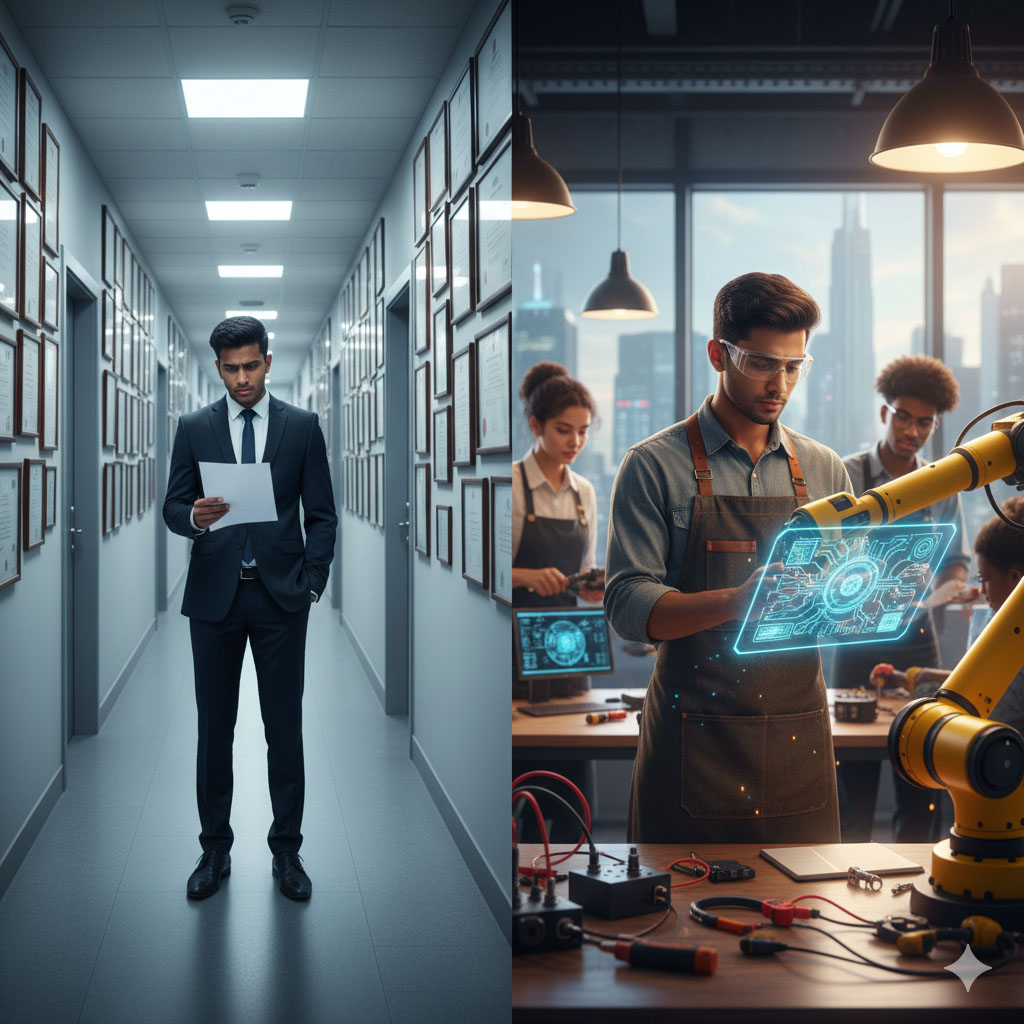
The Degree Trap: My Journey Through the Education System
From the very first day of school, I was conditioned to believe that the sole purpose of studying was to get a job. As I moved to higher classes, the focus shifted entirely to academic scores. Physical education classes were often taken over by teachers to finish “important” subjects. When my height became a barrier for NCC, I joined the Scouts and Guides, but soon that too was discontinued at my school. Vocational training and crafts, which could have taught us real-world skills, vanished from the curriculum by the 7th or 8th grade.
After the 10th, I realized that my marks decided my Plus Two stream, and Plus Two marks decided my higher education. Finally, after completing my degree, the reality hit me: A degree alone does not guarantee a job. You are left with two choices—write competitive exams for government jobs or hunt for private employment. That is when I realized that the fastest and most effective path to employment is vocational education.
The Power of Vocational Education
In both local and international markets, the highest demand and salaries often go to those with specific technical skills. Vocational education is a direct route to the workforce because it focuses on practical training and job-ready skills.
Unlike traditional academics, vocational training emphasizes craftsmanship, technical expertise, and self-employment readiness. Whether it is IT, healthcare, or hospitality, these programs provide specialized knowledge and hands-on experience through apprenticeships, allowing students to enter the workforce much faster.
The Crisis of “Educated Unemployment”
A major cause of the current job crisis is the obsession with higher education and “white-collar” jobs. This has led to a phenomenon known as educated unemployment. Many graduates hold certificates but lack the skills required for the industry, forcing them to accept low-paying jobs or remain unemployed.
The truth is, not everyone will get a government job, a white-collar role, or a chance to move abroad. Our education system rarely teaches us how to succeed in life, manage finances, identify our innate talents, or start a small business. While vocational education exists, its importance is often overlooked by parents.
Education is More Than Just a Job Search
Education is a powerful force that should bring personal development and social progress. It should sharpen a person’s thinking and make them self-reliant. When education is combined with a specific skill, an individual becomes capable of solving social problems and proposing new ideas. Education isn’t just a means to get a job; it is essential for the growth of the individual, the family, and society.
The Role of Parents in a Changing World
Most parents dream of seeing their children in high-status jobs. In this pursuit, they often fail to ask: What does the child want? What are their natural talents? What are the job market trends of the future?
If parents encourage skill-based education, we can solve the unemployment crisis to a great extent. A child trained vocationally has a much higher chance of success because they possess a tangible skill that the world needs.
Financial Freedom and the AI Era
We are entering the age of Artificial Intelligence (AI). Many traditional jobs will change or disappear forever. However, hands-on vocational skills—those based on human dexterity and practical problem-solving—will never become irrelevant. A person with a specific skill can survive anywhere in the world with confidence. You don’t have to beg for a job; you can provide a service and earn independently.
Vocational education doesn’t require years of waiting or massive student loans. It offers a faster path to income and financial independence. The foundation of any nation isn’t just high-ranking officials; it’s the technicians, craftsmen, and service workers who keep the world running.
Conclusion: Dignity of Labor
A significant hurdle for many graduates is the hesitation to take up “small” jobs. While dignity is important, deciding that you will only do a white-collar job is a personal loss. It is often better to have a daily income from a skill than to wait indefinitely for a monthly salary that may never come.
High education expands your worldview and thinking capacity, but it is only complete when paired with a professional skill. Education gives you confidence, but vocational skill gives you courage.