
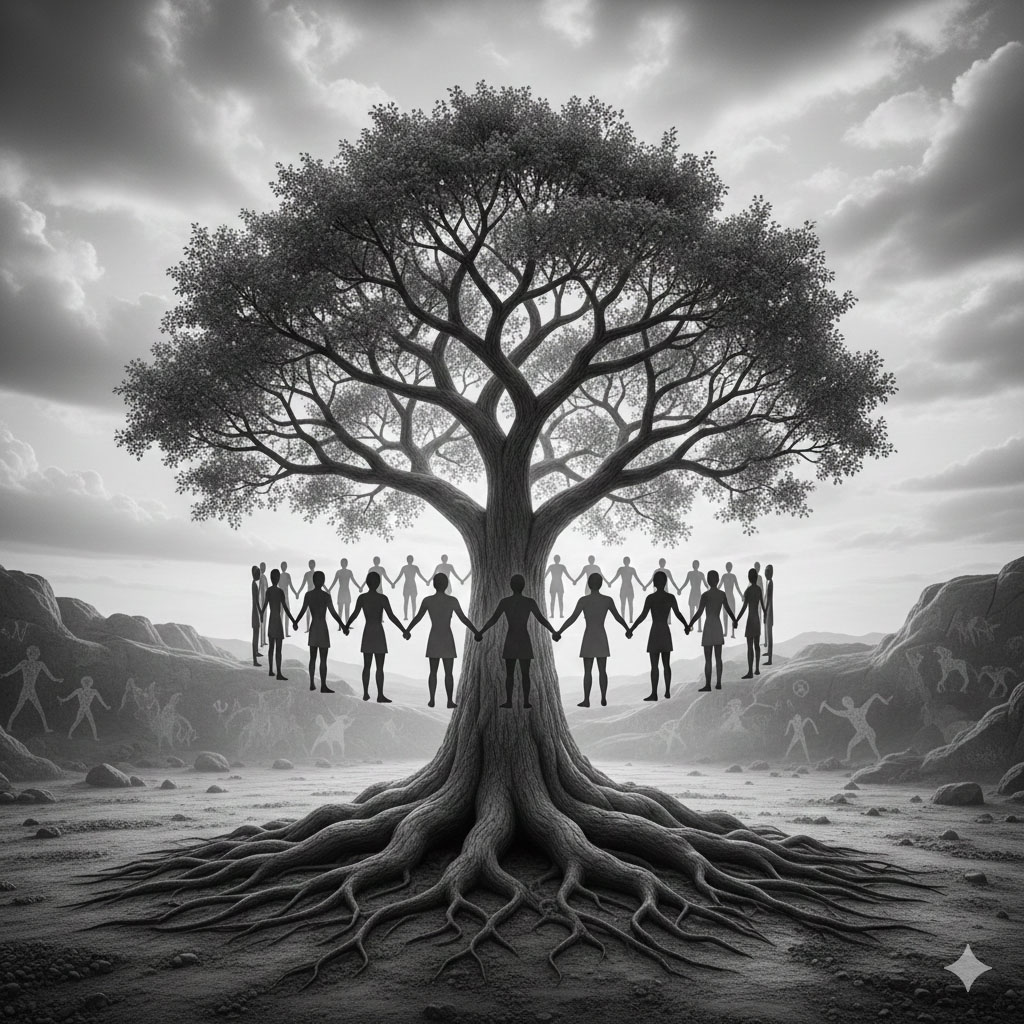
The universe began 13.8 billion years ago. The Earth formed 4.5 billion years ago. Around 2.5 million years ago, the first humans appeared in East Africa. It is important to note that humans did not evolve from monkeys; rather, humans and chimpanzees share a common ancestor. From that point, both lineages diverged and evolved separately. Based on discovered evidence, the earliest human ancestor was named Australopithecus. This was followed by Homo habilis, Homo erectus, and Homo neanderthalensis (Neanderthals), who evolved in Europe and Asia.
The final modern human species to evolve was Homo sapiens, appearing in Africa approximately 200,000 years ago. About 70,000 years ago, Homo sapiens migrated from Africa to all corners of the world. This migration took thousands of years, during which they encountered and interacted with ancient human groups like Neanderthals and Denisovans. By 45,000 years ago, Homo sapiens crossed the seas to reach Australia, a land previously untouched by humans.
The diverse forms, features, and colors of humans we see today are the results of adapting to different climates, diets, and lifestyles. From the Arctic to dense rainforests and scorching deserts, humans adapted to survive. In the intense heat of Africa, humans developed dark skin for protection. In colder regions, humans developed lighter skin to compensate for the lack of Vitamin D. No previous human species was able to adapt to such a wide variety of global environments, which is why Homo sapiens eventually spread across the entire planet.
Scientifically, every human on Earth belongs to a single species: Homo sapiens. All humans living today, and those who have passed, are the products of a long social and biological transformation. Our DNA is 99.9% identical. Due to centuries of migration and mixing, no population on Earth is “pure.” Differences in facial structure, hair texture, and skin color are merely adaptations to local environments. “Race” was actually a pseudoscientific theory developed during the colonial era to justify social hierarchies, conquest, and slavery.
Biologically, all humans share the same blueprint: a head, body, and limbs, with internal organs, bones, and muscles. Our vital organs—the brain (control center), heart (blood pump), lungs (breathing), kidneys (waste filtration), and our skeletal, nervous, and digestive systems—function in the exact same way.
Racism
Racism is the practice of acting with prejudice, discrimination, or hostility toward an individual or group. It stems from the false belief that one group is superior while others are inferior. Racism is a process that creates inequality through systems, policies, actions, and attitudes.
Racism has no place in modern society. No individual can survive without being part of a larger community. The products we use every day are made by different people in different countries. A nation’s growth is not the contribution of a single group; economic progress relies heavily on international trade and cooperation. Racism loses its logic the moment we step into a hospital—from blood transfusions to medical breakthroughs, we are all interconnected.
The Universal Declaration of Human Rights (1948) established that all humans are born free and equal in dignity and rights. Furthermore, the UN International Convention on the Elimination of All Forms of Racial Discrimination (1965) legally binds nations to eliminate racial discrimination in both public and private sectors.
Racism was introduced into history as a social construct and has persisted as a system to control society. It was used to justify the unequal treatment of people and to allow certain social classes to dominate others. Over generations, it has become a systemic issue leading to the vast inequalities we see today. Humans who share 99.9% of the same genes have been divided by this construct. It is a legacy of the past that continues to exist in various forms today.
Impacts
The impact of racism affects a person’s entire life. Constant exposure to discrimination leads to anxiety, stress, and depression. Over time, these mental health struggles manifest as physical ailments, including high blood pressure, heart disease, sleep deprivation, and chronic inflammation. It also leads to social, professional, and educational exclusion.
While we often categorize humans by gender, we must remember that all humans are fundamentally one and equal. What makes an individual unique is their mental and physical character, not their “race.” Racism is a belief system rooted in hate, used as a weapon to mistreat, oppress, and attack others. It is an ideology based on prejudice.
Conclusion
Racism is not a natural phenomenon; it is a mindset consciously constructed by humans. Scientifically, we are all branches of the same tree; our blood and our biological functions are identical. External differences are merely signs of geographical survival.
In the modern world, the persistence of racial discrimination is an insult to humanity. We must break down the walls of hatred and learn to see humans as humans. We should celebrate our diversities instead of fearing them and stand together for a society that ensures equal justice and dignity for all. A world without racism is not just a dream—it is a goal we must achieve through knowledge and mutual love.