
Once during a journey, I encountered a massive crowd and a long queue of vehicles blocking the road. When the traffic didn’t move even after a while, I pulled over my vehicle to find out what was happening. Upon reaching the spot, I saw two men being forcefully held back by a group of people. When I asked around, different people narrated different versions of the incident. Unsure of whom to believe, I walked up to a nearby tea shop and asked the shopkeeper, “Brother, what exactly is the issue here?
“He replied: “A group of young men came to my shop, drank some water, and were sitting on their motorbikes singing songs. While singing, one of them forgot the lyrics, and his friends started teasing him and laughing. Right at that moment, these two older men happened to walk by. They mistakenly felt that the youngsters were mocking them. The two men walked up to the youth and aggressively asked, ‘Why are you laughing?’ The youngsters shot back, ‘Why can’t we laugh?’ It quickly escalated into a heated argument, with shoving and pushing. In the heat of the moment, the two men picked up a wooden rod lying on the ground and started hitting the boys, who began to run. A crowd soon gathered, restrained everyone, and alerted the police.
“When the locals dug into the details, it became obvious whose fault it was. However, the two older men were consumed by ego and a deep sense of embarrassment. They kept arguing, “We are absolutely not the cause of this fight!” While the argument was ongoing, the police arrived and inquired about the details. When the police scolded the two men, they initially tried to argue back, but soon fell silent, their faces wearing an expression of realization that they had messed up. Eventually, the police put them in the jeep and drove away.
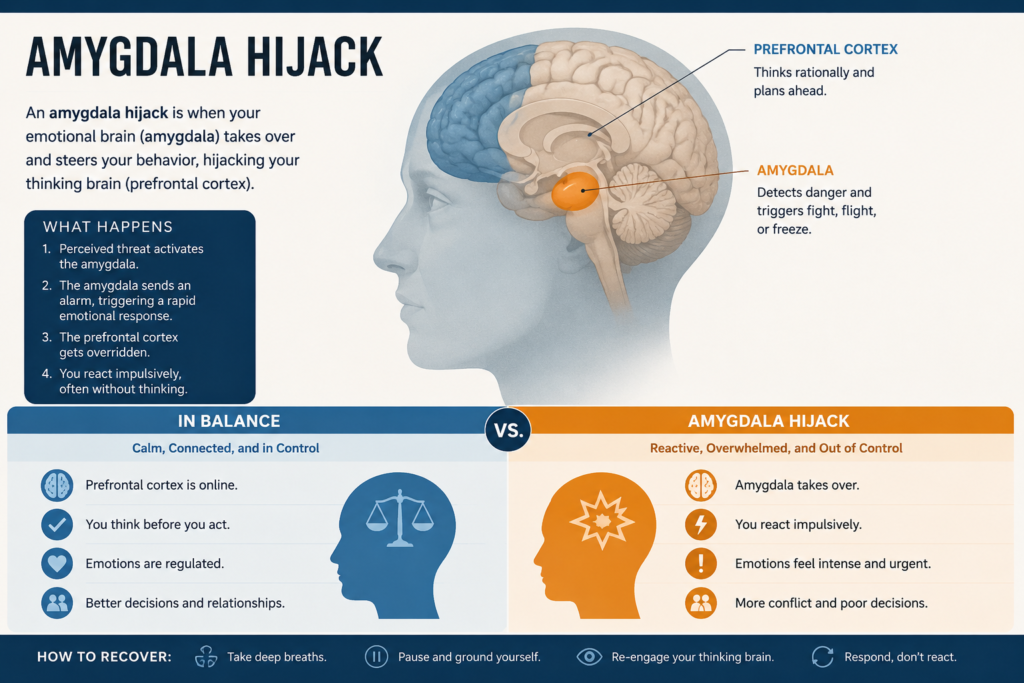
What is an Amygdala Hijack?
At some point in life, we have all completely lost control of ourselves in a moment of sudden anger or fear. We might have blurted out something completely irrational during an argument, or fallen into deep anxiety over a minor crisis. Once that moment passes and we calm down, we inevitably ask ourselves: “Why did I react that way? What came over me at that moment?
“What actually happens there is a profound psychological and scientific phenomenon that goes deeper than we think. It is called an Emotional Hijack or an Amygdala Hijack. This is a state where emotions completely take your rational thinking hostage.
The Science Behind Emotional Hijacking
If we examine the structure of the human brain, we can easily understand the science behind this. Part of the brain’s limbic system, located on both sides of the temporal lobes, is an almond-shaped structure called the Amygdala. This is the processing center for core emotions like fear and anger.
On the other hand, the Prefrontal Cortex, located right behind our forehead, is responsible for logical thinking, analyzing situations, and making rational decisions
[External Threat / Trigger] │ ├──► (Shortcut Path) ──► Amygdala (Emotions / Immediate Reaction) │ └──► (Normal Path) ──► Prefrontal Cortex (Logic / Rational Thought)
Whenever we perceive a danger or a threat, the information triggers the amygdala before it even reaches the prefrontal cortex for logical processing. The amygdala immediately pumps stress hormones like adrenaline and cortisol into the body. This triggers a ‘Fight-or-Flight’ response. In this state, you either attack, retreat, or freeze, completely paralyzed.
Triggers like criticism, loud arguments, or sudden, unexpected changes cause immense stress, pushing us into this state. It forces a person to react purely based on emotion.
For primitive humans, this rapid reaction from the amygdala was absolutely necessary to save their lives when facing wild animals. However, in today’s modern digital era, we experience that exact same perception of a life-threatening hazard over a simple text message, an office argument, or a personal disagreement. In these moments, logical thinking loses its grip entirely, and the amygdala effectively hijacks the brain.
Amygdala Hijack in Daily Life
This phenomenon explains why some people display intense aggression when they consume alcohol. Alcohol primarily numbs the prefrontal cortex—the region that governs our logical thinking. Once the prefrontal cortex’s control over the amygdala is compromised, there is no filter or restraint on the words and emotions that pour out. This is why the decisions made under the influence are often deeply flawed.
Similarly, if two people are engaged in a physical brawl, you should never jump right into the middle to separate them. It is always better to try and stop it before the first blow is struck. This is because, during a fight, they are experiencing a full-blown ‘Amygdala Hijack.’ They lose the rational capacity to recognize who is standing in front of them.
A Personal Reflection: I remember when I was in school, two of my friends got into a massive fistfight. I rushed in to break it up, but instead of stopping them, I ended up taking the brunt of the blows myself! The reality is that people caught in a physical fight completely fail to notice the individuals trying to help them at that moment.
Chronic Stress and the Amygdala
In today’s fast-paced world, the continuous mental stress we experience keeps the amygdala in a constant state of hyper-alertness (hypersensitivity). This state is incredibly harmful to a person—both physically and mentally—even over short periods. It doesn’t just destroy personal relationships; it also leads to chronic depression, anxiety, and physical illnesses.
When stress levels are high, we tend to meddle in situations without assessing them properly, often asking for trouble. We react sharply to minor things that have absolutely nothing to do with us. High stress forces us to question everything defensively, triggers sudden outbursts of anger, and breeds constant suspicion. Physically, this manifests as headaches, a racing heartbeat, and severe insomnia.
Ways to Overcome an Amygdala Hijack
We can train our brains to break free from the prison of overwhelming emotions through a few practical, daily habits:
Mindfulness and Meditation: Mindfulness is the practice of training your mind to focus entirely on the present moment. It teaches you to observe your emotions neutrally as a detached bystander, without judging them as good or bad. Regular meditation calms an overactive amygdala and strengthens its connection to the prefrontal cortex.
Deep Breathing: Taking deep, slow breaths during an emotional trigger instantly activates the body’s parasympathetic nervous system. This slows down your heart rate and sends a signal to your brain that everything is safe. A highly effective method is the ‘4-7-8’ technique (inhale for 4 seconds, hold your breath for 7 seconds, and exhale completely over 8 seconds). It works wonders in calming an agitated mind.
Cognitive Reframing: Identify the irrational fears and negative thoughts inside you and actively correct them. Instead of spiraling into a thought process like “Everything is ruined,” train your mind to reframe it: “This is just a temporary challenge, and I have the capacity to handle it.
“Progressive Muscle Relaxation (PMR): Mental stress physically tenses up our muscles. PMR is an exercise where you consciously tense specific muscle groups tightly and then slowly release them. This physical release calms the nervous system and dampens the intensity of the amygdala’s response.
Regular Physical Exercise: Working out releases ‘endorphins,’ also known as happy hormones. These hormones actively lower the levels of the stress hormone cortisol. Studies prove that people who exercise regularly possess a stronger prefrontal cortex, giving them a much higher resilience against daily stress.
Social Connections: Opening up and talking to trusted friends or family members provides immense emotional relief. Healthy social bonds act as a natural shield against mental stress. The more you bottle up your problems inside, the more severe your psychological distress will become.
Quality Sleep: A lack of sleep makes the amygdala hyper-sensitive. This is precisely why we feel incredibly anxious and irritable on days when we haven’t slept well. Ensure you get at least 7 to 8 hours of uninterrupted, quality sleep every single night.
Conclusion
Human emotions are entirely natural. However, problems arise when those emotions take complete control of our lives. The ultimate key lies in learning to recognize the exact moment your emotions are trying to hijack you. If you can manage to take just one pause, step back, and breathe deeply before reacting, you have already won the battle.
Challenges will always be a part of life. But if we can choose how we approach those challenges, we will succeed. Those who can master their emotions possess true patience, and they are the ones who ultimately survive. We must deeply reflect on whether it is genuinely necessary to react to every single occurrence in our lives and the lives of those around us. Ultimately, external events are completely out of our control.
“Never make hasty decisions on the back of intense emotions. Once the moment passes, human ego will step in, preventing your mind from re-evaluating the choice—even if it knows the decision was entirely wrong.”