
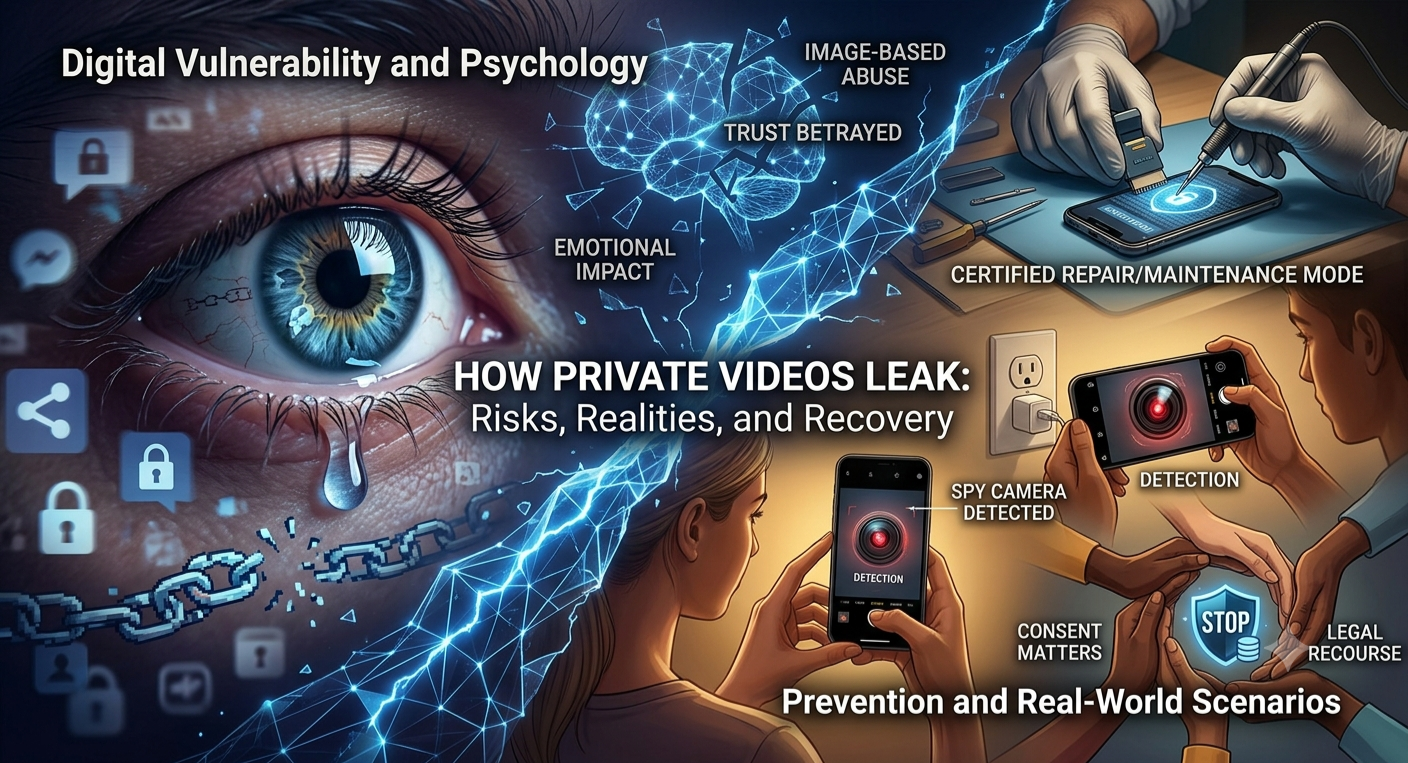
Digital Privacy in the Modern Age: How Private Videos Leak, Underlying Realities, and Preventive Measures
We live in a hyper-connected digital world where almost all information is just a click away. Knowingly or unknowingly, our personal data has become an inseparable part of this online space. In modern times, personal privacy has become increasingly fragile. Private media—often captured in moments of mutual trust, deep affection, or emotional intimacy—can spread across the globe within minutes once compromised. People do not record private moments for public consumption. Yet, when privacy boundaries are breached, these files circulate rapidly across social media, messaging apps, and unauthorized websites, leaving behind deep psychological pain for those depicted and their loved ones.
Behind every compromised private video is a real human being—someone who placed their trust in another, believed in basic confidentiality, and never consented to go viral. Yet somehow, that content is thrown into the public domain. It is often said that one truly understands such profound pain only when it happens to oneself or a loved one; may no one ever have to experience such an ordeal. What sets humans apart from other living beings is our intellect, emotional intelligence, and natural curiosity. Unfortunately, malicious actors exploit human curiosity to peddle voyeurism and compromise personal dignity.
How do these privacy breaches actually happen? In most cases, they stem from a combination of technical oversight, betrayal of trust, and deliberate cyber exploitation. Understanding digital awareness, ethical responsibility, and the protection of human dignity in the digital era is critical.
The Reality of Privacy in a Digital Space
Complete privacy in the digital ecosystem is often a misconception. Rather than stating “this is my private phone,” it is more accurate to view it as “an electronic device I purchased and operate.” Vulnerabilities exist where third-party apps with excessive permissions, cyber attackers, and unauthorized technicians can potentially access and copy files.
Once content is published or uploaded to open online platforms, permanently erasing it becomes nearly impossible. Even if removed from a primary profile or account, other users may have already downloaded or screenshotted the material. Data scrubbed from the surface web often persists across dark web forums, private cloud folders, or individual storage drives, re-circulating under altered file names. Unscrupulous actors exploit these breaches for ad revenue, clickbait traffic, or illicit monetization.
5 Psychological Dimensions of Image-Based Abuse
The unauthorized distribution of intimate media is one of the most severe personal violations of the digital era. Broadly categorized as Image-Based Sexual Abuse (IBSA) or non-consensual image sharing, this is rarely just an act of petty revenge; it is an exercise of abusive power and gender-based violence.
Research highlights five key psychological and behavioral dynamics surrounding these violations:
- Trust as the Foundation of Sharing: In modern intimate relationships, sexting and sharing private media often occur as natural expressions of vulnerability, affection, and mutual trust. An implicit, unspoken ethical contract exists that the shared content remains strictly within the confines of that relationship. Sharing under these conditions reflects human intimacy, not carelessness.
- Betrayal When Dynamics Shift: When relationships deteriorate or boundaries break down, that initial trust can be weaponized. The shared material creates a severe power imbalance, turning into a tool for emotional leverage or intimidation if one partner attempts to exit the relationship.
- Weaponization, Coercion, and Control: Intimate content is frequently used to maintain dominance. This manifests as coercive control (trapping a person in a relationship through persistent threats), sextortion (demanding financial payment or further sexual compliance under duress), and malicious character assassination driven by bruised egos or resentment.
- Digital Proliferation and Viral Networks: Once leaked online, structural internet mechanics make retrieval exceptionally difficult. Private forums, decentralized messaging channels, and dark web repositories trade stolen content like illicit currency. Algorithms designed to maximize user engagement accelerate viral distribution, while anonymity shields perpetrators from immediate exposure.
- Trauma and the Injustice of Victim Blaming: Survivors endure devastating psychological and social consequences, including Post-Traumatic Stress Disorder (PTSD), severe depressive episodes, panic disorders, and suicidal ideation. Many face disrupted careers, discontinued education, and social alienation. This trauma is exacerbated by societal victim-blaming, where communities interrogate the victim’s choices rather than holding the perpetrator accountable.
Image-based sexual abuse is not purely a technological flaw; it is the consequence of entitlement, disregard for consent, and predatory digital power dynamics. Halting these violations requires holding perpetrators and distributors strictly accountable under the law while eliminating victim-blaming cultures.
Common Pathways for Private Media Leaks
Private files are compromised through both technical vulnerabilities and breaches of personal trust:
- Mobile Repair Shops and Service Centers: Submitting an unlocked device or handing over PIN codes for screen replacements or diagnostics grants technicians unmonitored access. Unethical handlers can copy photo libraries, messaging folders, and cloud backups to external drives, or secretly deploy background tracking tools.
- Data Recovery on Second-Hand Devices: Standard file deletion or basic factory resets do not immediately wipe flash storage; they often only erase the file directory pointers. Secondary buyers or third-party dealers using standard data recovery utilities can easily retrieve residual images, videos, and chat backups.
- Hidden and Spy Cameras: Micro-lenses can be concealed inside common fixtures such as smoke alarms, power adapters, wall clocks, LED bulbs, air fresheners, and two-way mirrors. These are frequently deployed in vulnerable spaces like rental lodgings, trial rooms, and shared changing facilities.
- Hacking, Malware, and Phishing: Deceptive links sent via messaging apps or emails can harvest credentials for cloud storage platforms like Google Photos and Apple iCloud. Furthermore, sideloading unverified third-party apps (such as modded messaging clients) grants background access to cameras, microphones, and storage.
- Peer-to-Peer Breaches and Snooping: Casual device lending—such as allowing acquaintances to play games or make calls—can lead to unauthorized gallery browsing, file transfers via AirDrop or Bluetooth, and subsequent distribution into private chat circles under the guise of casual banter.
Essential Personal Security Precautions
- Prior to Device Servicing: Always enable native security protections like Android’s Maintenance Mode or Apple’s diagnostic safeguards. If unavailable, perform a full external backup followed by a clean factory reset before handing the device over.
- Prior to Selling Pre-Owned Devices: Ensure device storage encryption is active before performing a factory reset. For absolute security, overwrite residual storage by filling the empty space with non-sensitive large files (dummy data) before executing a final reset.
- Account Security: Enforce hardware- or authenticator-based Two-Factor Authentication (2FA) across all primary email, cloud storage, and social accounts.
- Detecting Hidden Cameras: In unfamiliar hotel rooms or changing spaces, dim the lights and inspect suspicious objects using your smartphone camera or an optical lens detector to identify unusual infrared signals or lens reflections.
Legal Recourse and Immediate Response
Distributing, recording, or storing intimate media without explicit consent is a punishable criminal offense across major jurisdictions, carrying substantial prison sentences and financial penalties. Adding extortion or blackmail to these actions leads to aggravated criminal charges.
If your private media has been compromised without your consent:
- Avoid Self-Blame: You are not at fault for another person’s criminal breach of trust.
- Preserve Evidence: Document all messages, URLs, phone numbers, and extortion attempts using dated screenshots.
- Report Immediately: Notify trusted family members, contact local law enforcement, and file a formal cybercrime report with national reporting portals (such as the Cyber Crime Helpline 1930 or cybercrime.gov.in in India, or relevant national equivalents abroad).
- Utilize Content Removal Tools: Leverage specialized victim-support mechanisms (such as StopNCII.org and platform-level takedown requests) to block the hash signatures of the media and disrupt further distribution.
Disclaimer: The security vulnerabilities and concerns discussed in this article are solely intended to build consumer awareness, promote digital safety, and highlight potential technical loopholes. The vast majority of mobile repair shops, certified pre-owned device dealers, and hospitality businesses operate with high professional integrity and strictly respect customer privacy. Mentioning these specific scenarios is meant only to alert users against rare, isolated malpractices and to encourage proactive precautions, not to generalize or undermine the credibility of these essential services and businesses.
Author’s Note: This article synthesizes insights from behavioral and cyberpsychology studies on non-consensual image sharing, combined with practical cybersecurity best practices.