Social Media: The Illusion of Connection
To many, social media is viewed as an inherently negative space. Yet, there is nothing fundamentally wrong with using it. It serves as a powerful medium to discover new perspectives, learn, expand businesses, nurture relationships, and pass the time. To a certain extent, social media even empowers individuals to bring personal and societal grievances to the attention of those in power, paving the way for real-world solutions.
To govern this, platforms enforce strict age limits and content guidelines, while governments worldwide draft regulations tailored to their national security. However, these rules are rarely enforced perfectly.
What is the Core Purpose of Social Media?
Social media emerged to fulfill fundamental human needs: connection, entertainment, and information. We use it to stay in touch with family and friends, track global news, build professional networks, and promote businesses.
In this modern era, it is entirely possible to live without social media. In fact, a vast majority of the global population does not use these platforms. However, when loved ones live oceans apart, social media becomes essential because it bridges the physical distance. It is crucial for staying informed and accessing a wealth of knowledge.
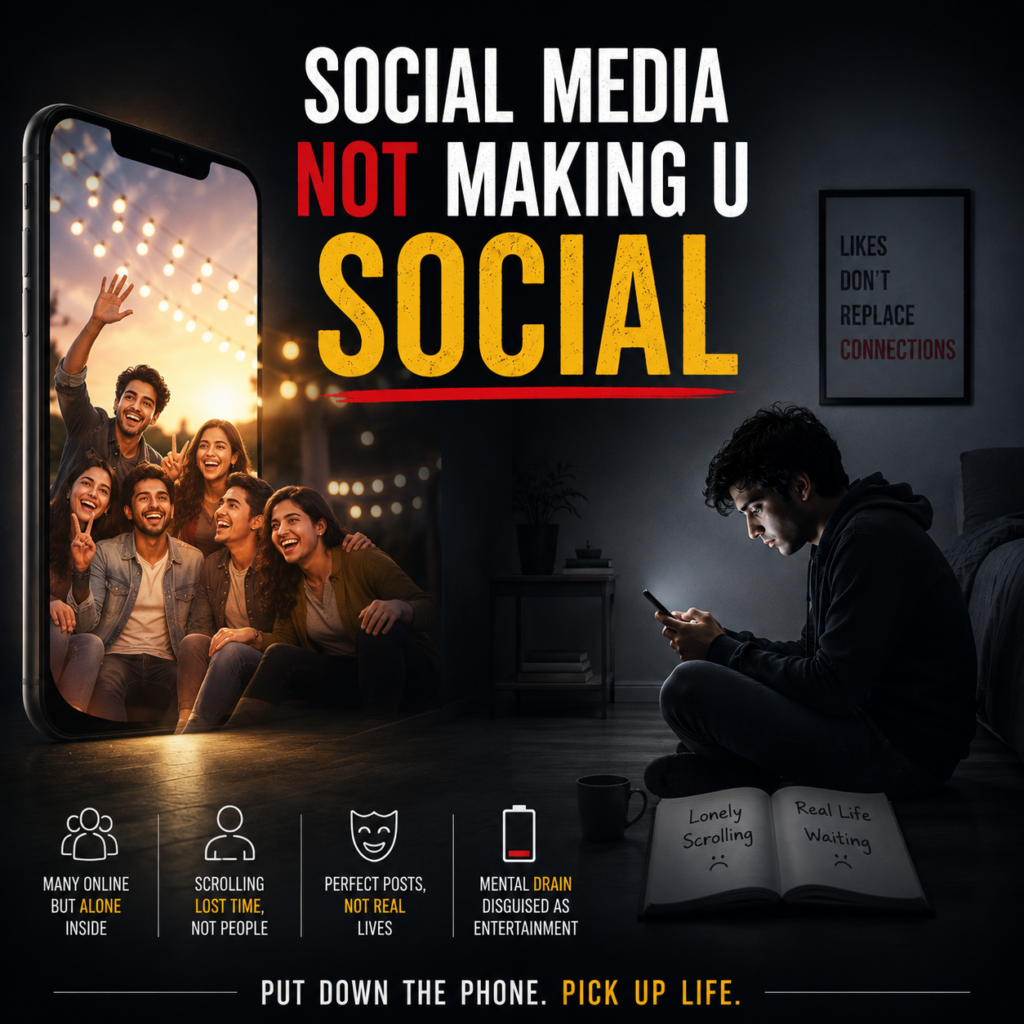
Yet, as the old proverb goes, “Too much of anything can turn into poison.” Excessive social media usage does not make us social; instead, it isolates us and breeds addiction. Prolonged, compulsive use inevitably takes a heavy toll on our physical and mental well-being.
Evolution and the Digital Void
Human beings are the product of millions of years of survival and evolution. Since ancient times, we have thrived as deeply communal, social creatures. Yet today, under the heavy influence of social media, we barely speak to the fellow human beings sitting right next to us. We spend the better part of our day staring into screens.
Ironically, what humans are searching for on social media is other humans. But when we overindulge in the digital world, we are actually exiting real social life. This hyper-consumption directly triggers brain fog, addiction, and FOMO (Fear of Missing Out). For children and young adults, this pattern inevitably culminates in deep, long-term isolation.
Social Media Addiction: A Historic US Court Verdict
Recently, a landmark court verdict in the United States captured global attention. This case forces us to reflect deeply and has the potential to alter the future of how we interact with social media.
A young woman who had used social media since childhood found that various platforms had become the centerpiece of her existence. Over time, she became entirely incapable of stepping away from them. Severe psychological distress, anxiety, and body dysmorphia began tearing her life apart. Driven by this, she took the tech giants to court.
The Court’s Groundbreaking Finding: The court recognized that social media platforms are deliberately engineered to hook users and maximize screen time. Features like:
- The infinite scroll
- Video auto-play
- Push notification ecosystems
These design choices are intentionally built to psychologically manipulate users into staying trapped inside the app. Consequently, the court held the tech corporations liable and ordered them to pay damages.
This verdict is not merely a victory for one individual; it sends a massive message to the world. The issue isn’t just our personal “usage”—it is the fact that these systems are systematically designed to addict us. This opens the floodgates for future litigation, forcing companies to fundamentally restructure their design ethics.
This case confronts us with a vital question: “Are we using social media, or is social media using us?”
The American court’s ruling was not just a legal standard; it was an urgent warning: “Social media is not just a tool; it is a force that actively shapes our minds.” We must control it, or it will control us.
Crafted Illusions and Digital Conflict
Not everything presented on social media is accurate. We only ever see one side of a story, yet we rarely pause to investigate whether what we are consuming is true or false.
Whenever someone publishes a post, factions immediately form—those who agree and those who disagree. Under the guise of “freedom of speech,” strangers turn into digital gladiators, warring with people they have never met. We exhaust our energy locking horns over matters that have zero relevance to our actual lives. Tragically, internet arguments have escalated to the point of real-world violence and homicide.
Social media content holds both immense good and deep antisocial elements. Bad actors across the globe use these platforms to spread mass misinformation, which is readily consumed by vulnerable minds, including children.
Consider the wave of online misogyny: certain groups of men create targeted, anti-women content, pushing narratives that all women are inherently malicious while men are blameless. Yet globally, statistics show that women remain the primary victims of systemic violence. By taking out-of-context clips of a few individuals or edited movie scenes, these creators paint a toxic, generalized picture of an entire gender. Conversely, misandrist content attacking men as a whole is also on the rise.
The Comparison Trap and Mental Health
Social media is a relentless comparison engine. People showcase only the absolute best, highly curated highlights of their lives. Consuming this round-the-clock makes us internalize a sense of lack, leaving us complaining, “Why can’t I achieve that? Why don’t I have that?”
Chronic social media consumption is directly linked to loneliness, sleep deprivation, chronic dissatisfaction, anxiety, and clinical stress. Psychological distress is spreading through modern society like an epidemic, and excessive social media use is a major catalyst.
Human beings traditionally gather to exchange ideas and nurture a collective social consciousness. Today, digital addicts will sit together in the same room, entirely ignoring one another, completely absorbed in their phones. The more time we invest in virtual spaces, the steeper the decline in genuine communication and deep human bonds.
Interestingly, high-profile individuals, celebrities, and top-tier content creators often use social media the least. Their pages are almost entirely managed by external teams.
The Human Antidote
The ultimate cure for a human being is another human being. That is exactly why people search for human connection on social media in the first place. But if we fail to communicate with those around us, no amount of online interaction will make us truly social creatures. In a crisis, it is your immediate neighbor, not an online follower, who comes to your aid.
While social media beautifully unites the globe under a single digital roof, it harbors a dark underbelly. Scams, fraud, and cyber-abuse are skyrocketing. Many fall into these digital traps knowingly or unknowingly. It is often only when law enforcement steps in that the smiling masks of these online predators finally slip off.
Social media was never meant for children. Countries worldwide are now implementing strict age regulations, recognizing that early exposure severely stunting children’s psychological and social development. It erodes emotional intelligence, blinds them to their innate talents, and detaches them from core human values. If a child grows up fed on toxic digital content and exhibits behavioral defiance, we cannot blame the child. A person’s thoughts and life trajectory are profoundly dictated by their environment.
Children are the architects of tomorrow; society bears the absolute responsibility to anchor them in human values. Because children lack the cognitive maturity to distinguish truth from manipulation, unmonitored social media access will inevitably lead them astray. These algorithms are wild and uncontainable; shut down one toxic page, and ten more will instantly rise in its place.
The Endless Loop of Hyper-Reality
What makes the human experience unique is our lived reality. Social media severely disrupts this. It can never offer genuine experiences because true experiences are processed organically by the brain, whereas social media serves a simulated, hyper-reality. While the brain can adapt to these digital simulations short-term, prolonged exposure inevitably fractures our mental health.
Social media set out to unify the world, but it ended up isolating the individual. It robs us of our ability to live in the present moment—to just be in the here and now. How many of us can sit quietly doing absolutely nothing? Almost no one. We scroll before we sleep, the moment we wake up, and even in the restroom.
No matter how far you scroll, the feed never ends. Social media is an infinite loop designed to ensure you never escape. Slowly, you become a prisoner of FOMO, constantly terrified that something monumental is happening online that you are missing out on. This fear keeps you perpetually tethered to the screen.
Everything on social media isn’t a lie—but it is far from the absolute truth. The vast majority of what you see is carefully staged, pre-produced content. We like to tell ourselves, “I am not addicted; I am in total control of my choices.” But it is worth taking a hard, honest look in the mirror to see how true that statement actually is.
The most priceless assets in life are your memories, and those can only be forged through real-world experiences. Your memories should not be populated by the curated lives of strangers. In the story of your life, you must be the main character—not someone else. It is time to let go of the exhausting compulsion to know everything happening across the globe at every single second.