
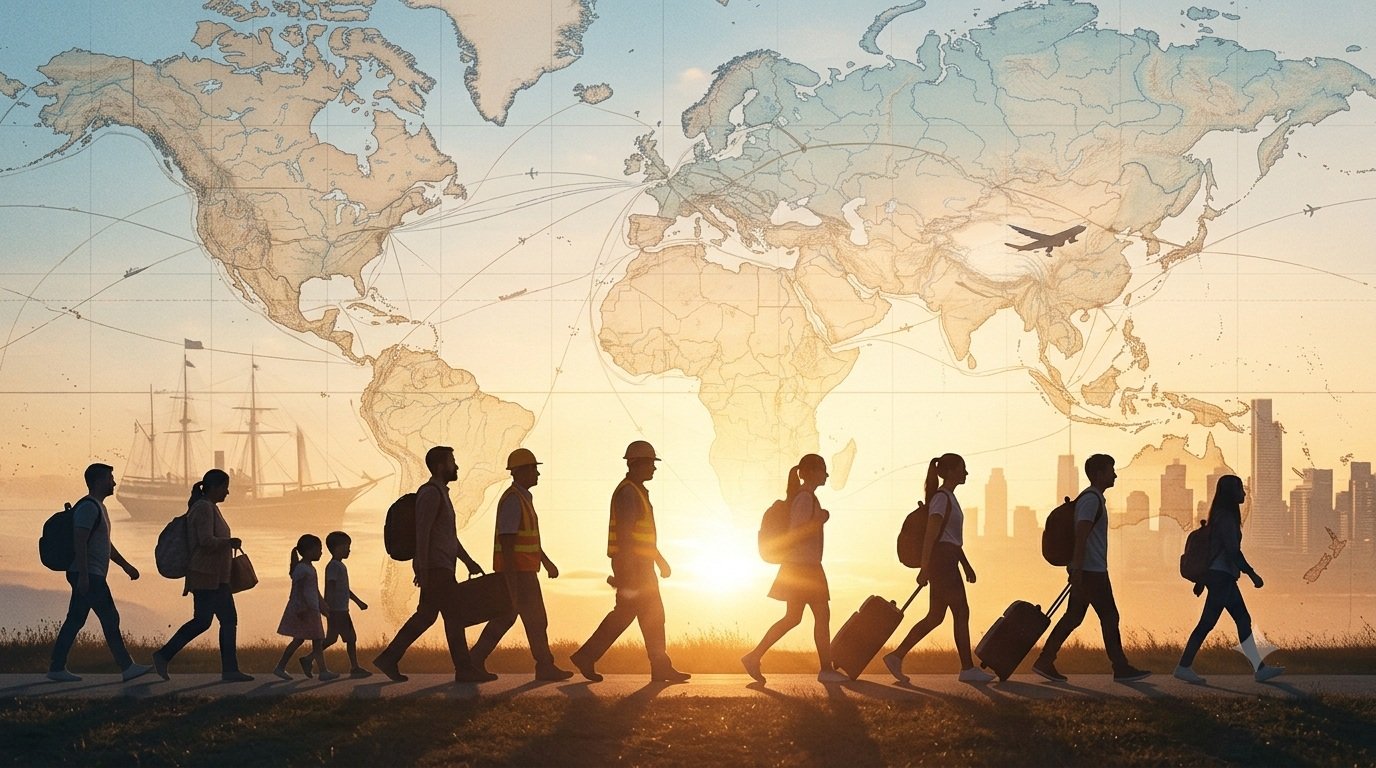
The History of Migration: Humanity’s Primal Journey of Survival
Human history begins with migration. Hundreds of thousands of years ago, early humans ventured out of the African continent in search of sustenance and safety, fanning out across continents to lay the foundation of today’s global population.
- The Agrarian Era and River Valleys: The movement of populations toward fertile riverbanks gave birth to ancient civilizations.
- The Colonial Era (16th Century Onward): European powers expanded into the Americas, Africa, and Asia; their conquest and settlement fundamentally redrew the geopolitical map. Fleeing poverty and famine across Europe, millions boarded ships bound for North America.
- Slavery and Forced Migration: Under British colonial rule, millions of laborers from India and Africa were forcibly displaced or indentured to work on plantations in Fiji, Trinidad, Mauritius, and other colonial territories.
- Post-WWII Reconstruction: To rebuild war-ravaged domestic economies, Western European nations actively invited foreign labor, initiating a transformative chapter in modern labor migration.
- Codification of Modern Frameworks: The 1951 UN Refugee Convention and the United States’ Immigration and Nationality Act of 1965 dismantled earlier national-origin quotas, establishing formal mechanisms for modern global migration.
History reveals an important truth: immigrants have played a significant role in building the modern industrialized world. Through their labour, resilience, skills, entrepreneurship and innovation, they have helped shape economies and societies across generations.
Legal vs. Undocumented Migration
The world is currently navigating a severe, multifaceted migration crisis. Across major host countries, heated political debates and public protests against immigration have surged. Alongside documented migration for higher education and skilled employment, undocumented border crossings and humanitarian refugee flows have expanded rapidly. Within contemporary geopolitics, migration broadly divides into two categories:
| Category | Nature | Common Pathways / Methods |
| Legal Migration | Entering a host country with valid documentation while adhering to its immigration laws and visa criteria. | Student visas, skilled worker programs (e.g., H-1B, Permanent Residency), investor/business visas, and family reunification. |
| Undocumented / Irregular Migration | Crossing international borders without authorization or remaining in a country after a visa has expired. | Human smuggling networks (such as “donkey routes”), circumventing border barriers, and hazardous maritime crossings on small boats. |
Positioned distinctly between these categories are refugees. Fleeing war, genocide, state terror, or targeted political persecution, these individuals are legally entitled to international asylum and protection under the 1951 Geneva Convention. However, developed nations increasingly struggle to distinguish between economic migrants seeking higher incomes and genuine refugees fleeing existential peril.
Why Do People Leave Their Homelands?
Few individuals willingly abandon their families, culture, and native soil to relocate to an unfamiliar land without compelling cause. Migration is fundamentally propelled by two counterbalancing forces:
1. Push Factors
Circumstances that make remaining in one’s home country untenable:
- Economic Distress and Unemployment: The absence of viable employment opportunities, stagnant wages, and an inability to achieve financial mobility.
- War and Civil Unrest: Armed conflicts, violent insurgencies, and systemic breakdowns of civil order.
- Political Repression and Institutional Corruption: Censorship, authoritarian crackdowns, institutionalized discrimination, and widespread corruption that stifles individual potential.
- Climate Change and Ecological Collapse: Prolonged droughts, severe flooding, and changing weather patterns eroding agrarian livelihoods.
2. Pull Factors
Prospects and assurances offered by destination nations:
- Higher Standards of Living: Accessible modern healthcare, high-quality public education, developed urban infrastructure, and personal safety.
- Competitive Wages and Social Safety Nets: Fair remuneration for labor, robust statutory protections, and reliable retirement security.
- Rule of Law and Civil Liberties: Institutional equality, personal autonomy, and protection from arbitrary state overreach.
- Generational Security: The opportunity to build a stable, prosperous foundation for future generations.
Why Developed Nations Welcomed Immigrants—and Why Borders Are Tightening
Western nations that once recruited foreign talent and labor are now curtailing intake and erecting stringent regulatory hurdles. Understanding this shift requires examining both economic eras.
Why Countries Previously Encouraged Immigration:
- Severe Labor Shortages: Declining domestic birth rates and rapidly aging populations left factories, farms, hospitals, and eldercare facilities facing critical staffing deficits.
- Economic Expansion: High tuition revenues generated by international students and broad income taxes contributed by foreign professionals bolstered public revenues.
- Territorial Scale: Countries with large landmasses, required population growth to develop regional economies and scale domestic industries.
Immigrant workforces served as a demographic buffer, preserving public balance sheets and supporting non-working segments of society.
Why Immigration Rules Are Being Tightened:
- The Housing Crisis: Rapid population growth outpaced residential construction, driving home prices and rental rates beyond the reach of local working- and middle-class families.
- Strain on Public Services: Backlogs in healthcare systems, extended hospital wait times, and overcrowded schools created deep domestic resentment.
- The Rise of Populist Politics: Political narratives alleging that foreign labor undercuts domestic wages and strains public resources have garnered substantial electoral traction.
- Abuse of Student Visa Pathways: The proliferation of private diploma mills serving as backdoor immigration conduits led regulatory bodies to restrict student intakes to protect institutional standards.
The Global Migration Map: Key Corridors and Flows
Top Destination Countries
- The United States: As the world’s preeminent economic power, it remains the most sought-after destination for international migrants. While its foreign policy and domestic politics frequently draw international criticism, millions still aspire to live there—a dynamic often described as the “American Paradox”.
- The United Kingdom and Western Europe: Highly coveted for comprehensive social security infrastructure, stable public services, and skilled labor opportunities.
- Canada and Australia: Historically favored for transparent, points-based permanent residency systems that accommodated large cohorts of skilled professionals and students.
- The Gulf Cooperation Council (GCC) Nations: Tax-free earnings, personal security, and steady employment make the Gulf a vital economic anchor for millions of Asian workers.
Top Origin Countries
- India: India has the world’s largest emigrant population, with approximately 18.5 million India-born people living abroad in 2024. Indian migration includes workers in Gulf countries, skilled professionals in North America and Europe, international students, and long-established diaspora communities worldwide.
- Mexico: Mexico is one of the world’s largest countries of emigration. Mexican-born residents form the largest immigrant-origin group in the United States, with approximately 11.1 million Mexico-born people living there in 2024. Migration is shaped by employment opportunities, family reunification, geographic proximity, and longstanding social and economic connections.
- China: China is a major source of international students, skilled professionals, researchers, entrepreneurs, and business migrants. Chinese migrants have established communities across North America, Europe, Asia-Pacific, and other regions. Education, employment, business opportunities, and family connections are among the factors influencing migration.
- Conflict Zones: Millions are fleeing instability and economic devastation, seeking asylum across wealthier nations.
Why Do Local Populations Resist or Fear Immigration?
Skepticism among domestic working- and middle-class citizens cannot simply be dismissed as xenophobia. While nativist hostility exists, public hesitation often stems from concrete socioeconomic anxieties:
- Wage Suppression Concerns: The fear that an influx of workers willing to accept lower wages diminishes the collective bargaining power of domestic laborers.
- Socio-Cultural Friction: Challenges in cultural integration when large groups of newcomers struggle to adapt to the secular, liberal norms of host societies, or when local traditions feel diluted.
- Security and Public Safety Concerns: Anxiety over unvetted border crossings and the perceived erosion of domestic border enforcement.
- Competition for Public Goods: The perception that subsidized public services and welfare systems, built through generations of domestic tax contributions, are consumed without proportional initial contributions.
Capitalizing on these genuine friction points, anti-immigration political movements have gathered unprecedented momentum worldwide.
Migration: Boon or Bane?
Migration is neither inherently an unalloyed positive nor a purely negative phenomenon; it is a complex socioeconomic reality.
- The Advantages: Injects demographic vitality into aging labor pools, alleviates shortages across sectors from agricultural fields to advanced research labs, broadens cultural diversity, and lifts families out of extreme poverty worldwide.
- The Drawbacks: Overwhelms municipal infrastructure when inflows exceed local carrying capacity, and inflicts severe “brain drain” on developing nations as educated doctors, engineers, and scientists emigrate en masse.
Measured, transparent, and structured migration functions as an economic asset, whereas unmanaged, unregulated immigration becomes an untenable burden for any host nation.
How Structured Migration Drives Global Prosperity
When implemented through coherent policy frameworks, migration produces shared economic benefits for both sending and receiving societies:
- Remittance Inflows: Capital sent home by migrant workers provides vital financial support for families, improves rural purchasing power, and stabilizes foreign exchange reserves across developing countries.
- Innovation and Technological Progress: A look at Silicon Valley illustrates this impact: global tech leaders like Alphabet and Microsoft are helmed by immigrants. Immigrant talent continues to serve as an engine of modern entrepreneurship and research.
- Demographic Stability: Young, economically active migrant workers remain essential to funding the state pensions and healthcare programs required to support aging populations across the industrialized world.
An aging populace alongside plummeting birth rates represents a structural threat to the solvency of developed economies. Bridging this demographic deficit requires sustained workforce participation, making structured immigration an economic necessity. To maintain fiscal and industrial viability, advanced economies will inevitably depend on international workers.
Every human being retains a natural aspiration to seek safety, dignity, and a better future through hard work. That foundational drive has guided human movement since our earliest ancestors traversed uncharted continents. Yet, in an era defined by sovereign nation-states and established legal codes, unregulated movement outside the rule of law cannot endure indefinitely without destabilizing social trust.
The modern world requires balanced, rational immigration frameworks: policies that protect the welfare, infrastructure, and social cohesion of host citizens while offering transparent, merit-based pathways to global talent. Behind every migration journey lies not merely an economic calculation, but the enduring human drive to endure, adapt, and build anew.