

The image shown above, the Pearly Blue Dot is an iconic photo of Earth taken by NASA’s Voyager 1 spacecraft on February 14, 1990. Voyager 1 was hurtling rapidly out of the solar system – beyond Neptune, about 3.7 billion miles (6 billion kilometers) from the sun. The image, known as the Pearly Blue Dot, shows Earth within a scattered beam of sunlight. Voyager 1 was so far away that – from its perspective – Earth was just a dot of light about the size of a pixel.
The Pale Blue Dot and Beyond
The famous astronomer Carl Sagan, after seeing the picture above, said, “Look again at that spot. That’s here. That’s home. That’s us. On it everyone you love, everyone you know, everyone you ever heard of, every human being who ever was, lived out their lives. The aggregate of our joy and suffering, thousands of confident religions, ideologies, and economic doctrines, every hunter and forager, every hero and coward, every creator and destroyer of civilization, every king and peasant, every young couple in love, every mother and father, hopeful child, inventor and explorer, every teacher of morals, every corrupt politician, every ‘superstar,’ every ‘supreme leader,’ every saint and sinner in the history of our species lived there—on a mote of dust suspended in a sunbeam.”
In the past, it was widely accepted that the Earth occupied the central position in the universe. This geocentric notion was eventually supplanted by the heliocentric model, with the Sun recognized as the nucleus of our solar system. Our solar system is nestled within the Milky Way galaxy, which is estimated to harbor between 100 to 400 billion stars. The Sun is orbited by eight major planets, including Earth, along with their respective moons and dwarf planets. At the gravitational core of the Milky Way lies Sagittarius A*, a supermassive black hole.
If one could travel at the speed of light from Earth to the center of the Milky Way, the journey would take an astonishing 26,000 years. The speed of light in a vacuum is approximately 300,000 kilometers per second. Interestingly, the universe has no identifiable center; every point appears to be moving away from every other point. Approximately 13.8 billion years ago, the universe began to expand from an infinitely dense and hot state, an event known as the Big Bang. This expansion of space itself continues today, and at extreme distances, the separation between galaxies exceeds the speed of light. Approximately 2 trillion galaxies have been estimated to exist in the observable universe, but many more likely exist beyond our cosmic horizon
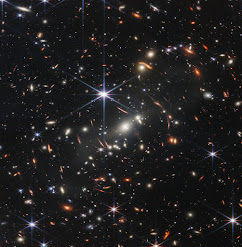
The image above shows thousands of galaxies packed into this near-infrared image of the galaxy cluster SMACS 0723. The finely detailed image is a combination of high-resolution imaging from NASA’s James Webb Space Telescope and a natural effect known as gravitational lensing.
The Big Bang
The Big Bang stands as the prevailing scientific explanation for the origin of the universe. About 13.8 billion years ago, the universe initiated its rapid expansion from a condition of extreme density and temperature. This event triggered the inflation of space, cooling the cosmos in the process. In the initial fractions of a second following the Big Bang, the universe’s high energy resulted in the formation of the first elementary particles, such as quarks and electrons, which soon formed protons and neutrons. Roughly 380,000 years later, as the universe cooled further, the first neutral atoms formed—principally hydrogen and helium.
Millions of years after the Big Bang, hydrogen and helium gases began collapsing under gravity’s influence, giving rise to the first stars. As gas clouds clustered together, their internal pressure and temperature increased until they triggered nuclear fusion. Our own solar system formed much later, around 4.6 billion years ago, beginning with the gravitational collapse of a solar nebula that created the Sun, followed by the protoplanetary disk that formed the planets.
Earth and the Evolution of Life
Approximately 4.5 billion years ago, our planet, the Earth, came into existence. Initially, it was a molten collection of rock, but as it radiated heat into space, a solid silicate crust began to form. The eventual presence of liquid water set the stage for life to emerge. Life likely began in the nutrient-rich waters of the early oceans, followed by the slow development of a breathable atmosphere. Around 3.5 to 4 billion years ago, complex organic molecules led to the creation of the first single-celled organisms. Over eons, these evolved into multicellular creatures, eventually developing specialized tissues and organs.
This evolutionary path led to the emergence of intricate aquatic organisms. The advent of photosynthesis by cyanobacteria resulted in a dramatic increase in oxygen levels within the Earth’s atmosphere. Eventually, life adapted to land, evolving into fully terrestrial beings. These organisms continued to diversify, resulting in the remarkable rise in biodiversity we see today, from the smallest insects to the most complex mammals.
The universe is immensely vast. Scientists estimate there are at least 2 trillion galaxies within the observable limit, each containing billions of stars. The Milky Way is merely one of these countless “island universes.” The expansion of the universe is actually accelerating. As discovered by Edwin Hubble in the 1920s, distant galaxies are receding from us, a phenomenon now attributed to the mysterious influence of dark energy.
Modern instruments, such as the Hubble and James Webb Space Telescopes, serve as our windows into the deep past. Utilizing these tools, scientists capture images of the cosmos by detecting light emitted billions of years ago, enhancing our understanding of the universe’s formative stages. Crucial evidence supporting the Big Bang theory is found in the Cosmic Microwave Background radiation, the afterglow of the early universe.
Conclusion
While the universe remains shrouded in mystery, fresh discoveries are unveiled daily. While many scientists suspect life exists beyond Earth given the sheer number of habitable zones, we have yet to find definitive proof. We are still searching for our neighbors in the cosmos. There lies a vast “unobservable” universe beyond the reach of our telescopes, where light can never reach us because the space between us is expanding too quickly. We may never fathom what exists there, as the universe continues to stretch toward infinity.
We cannot ascertain the current state of many remote celestial bodies, since the light we see left them millions or billions of years ago. We are essentially looking at “ghosts” of the past. Galaxies have been observed dating back to over 13.4 billion years ago. These represent the most remote and ancient structures known, existing merely a few hundred million years after the Big Bang itself.