
From Breathlessness to Realization: My Journey
In 2015, for the first time, I experienced shortness of breath in the early hours of the morning. I woke up from my sleep, sat up, walked around, and drank some warm water; nothing made a difference. When breathing became even more difficult, I went to the hospital. There, they gave me an injection and nebulization. After a little while, my breathing returned to normal. The doctor told me to come to the outpatient department (OPD) the next morning, but I didn’t go.
A few days later, I faced shortness of breath in the early hours of the morning again and went to the hospital. But this time, I went to see the doctor at the OPD in the morning. Since there was no pulmonologist available, I consulted a general medicine doctor. He prescribed medication and said, “If you get shortness of breath again, see a pulmonologist.”
When the breathlessness occurred yet again, I consulted a pulmonologist. Since I have allergies, he prescribed medications along with an inhaler to use whenever I experience breathing difficulties.
After that, though not permanently, my nose would get blocked during cold weather and when my allergies flared up. Slowly, without me even realizing it, I began breathing through my mouth. I thought to myself, “Well, I am able to breathe, and that itself is a good thing.”
It was only then that I realized breathing through the mouth is not good for health and that one must breathe only through the nose. Moreover, to receive the full benefit of the air, it must be taken in through the nose
Breathing: The Foundation of Life
Breathing is essential for the body to obtain the oxygen necessary to sustain life. When we breathe, air travels to the lungs and fills millions of tiny alveoli (air sacs).
Each alveolus is surrounded by a network of capillaries (tiny blood vessels).
Oxygen from the alveoli travels through their paper-thin walls and the capillary walls into the blood.
Inside the red blood cells, hemoglobin molecules bind with the oxygen and carry it along.
At the same time, carbon dioxide moves from the blood into the alveoli. Carbon dioxide reaches the alveoli from the blood so that it can be expelled from the body when we exhale.
The oxygen-rich blood returns to the heart, which pumps it to the rest of the body’s cells and tissues. The oxygen that reaches the cells is used to produce energy from food. Carbon dioxide is produced as a byproduct of this process.
Breathing is one of the fundamentals of life; if you breathe well, you will live a long time on this earth. Breathing is primarily an involuntary process of the brain to sustain life. It is controlled by the brainstem. We breathe automatically even while sleeping. Generally, we do not breathe through our mouth, but when the nose is blocked, we naturally start breathing through the mouth. However, mouth breathing is not good for health.
Benefits of Nasal Breathing
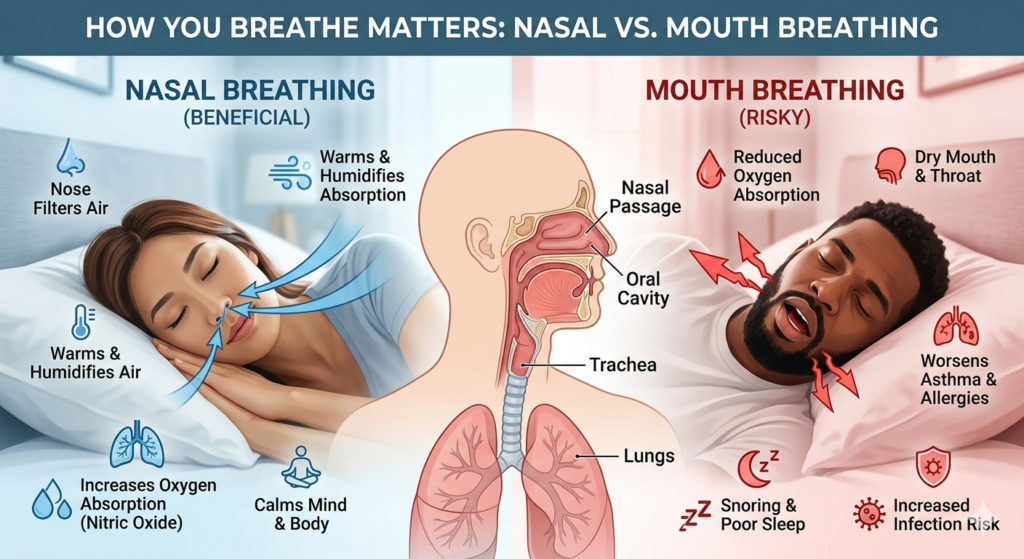
We can breathe not just through the nose, but also through the mouth. However, nasal breathing is crucial because it filters, warms, and humidifies the inhaled air. The nasal hairs trap dust particles. Breathing through the nose also produces nitric oxide, which increases the lungs’ oxygen absorption.
Because nasal breathing is slower, it improves the functioning of the diaphragm.
It stimulates the parasympathetic nervous system, which lowers blood pressure and heart rate, calming the mind and body and improving sleep.
When breathing through the nose, the higher level of carbon dioxide in the blood reduces the affinity between hemoglobin and oxygen (the Bohr effect). This causes an increase in oxygen delivery to tissues and organs
Problems of Mouth Breathing
Habitual mouth breathing causes health problems such as poor sleep, sleep apnea, snoring, daytime sleepiness, chronic fatigue, dry mouth, cracked or chapped lips, allergies, and bad breath. It increases the risk of tooth decay and gum disease. Furthermore, in children, it can cause misaligned teeth.
When you breathe through the mouth, the air is not filtered, warmed, or humidified. This leads to reduced oxygen absorption, increased respiratory tract infections, and can worsen lung diseases.
Mouth breathing always involves a higher volume of air; therefore, when hyperventilating (over-breathing), too much carbon dioxide is lost from the blood, leading to reduced oxygenation of tissues and organs.
Nitric oxide plays a crucial role in the oxidative capacity of muscles, which determines muscle strength. This highlights the importance of nasal breathing during heavy work or exercise because breathing through the nose produces nitric oxide.
The human being we see today has evolved. It is because of evolution that our brains developed, we survived, and technology was invented. However, as part of evolution, when humans began cooking food and eating it soft, the nose became smaller, the airway became smaller, and the volume of filtered air decreased. It was mostly after the Industrial Era that humans began breathing poorly.
Breathing is essential for the overall health of the body. A good percentage of humans do not take in the breath required to maintain health. Nasal congestion is a common problem faced by people worldwide, happening as a result of inflammation or allergies. Therefore, when unable to breathe through the nose, they start breathing through the mouth. When mouth breathing begins, the body fails to block germs. Illnesses will be fewer if you breathe through the nose.
Mouth breathing can cause or worsen asthma symptoms and anxiety. Cold, dry, and unfiltered air disrupts the airways.
How to Change Your Breathing Habit
Breathing through the nose helps you take slower, deeper breaths. This can reduce anxiety, stress, and blood pressure. Nasal breathing reduces the respiratory rate and helps deliver oxygen to the bloodstream faster. Moreover, activating the parasympathetic nervous system shifts the body into a rest-and-digest state.
Yoga and meditation promote nasal breathing. If you are breathing through your mouth, consciously practice breathing through your nose.
- Diaphragmatic (Belly) Breathing: Place one hand on your chest and the other on your belly. Inhale through your nose, and without opening your mouth completely, purse your lips and slowly exhale. Tighten your abdominal muscles.
- 4-7-8 Breathing: Inhale through your nose for 4 seconds, hold your breath for 7 seconds, and exhale completely through your mouth for 8 seconds.
- Box Breathing (4-4-4-4): Inhale through your nose for 4 seconds, hold your breath for 4 seconds, exhale through your mouth for 4 seconds, and pause without breathing for 4 seconds.
Note: Practice this for 5–10 minutes daily. Practice this during times of acute anxiety as well. Individuals with heart disease, high blood pressure, pregnant women, or those with chronic shortness of breath, COPD, or asthma should seek a doctor’s advice
Correct Oral Resting Posture:
Lips sealed – Your mouth should remain closed.
Teeth slightly touching – Not clenched tightly, but resting gently.
Tongue on the roof of the mouth – The entire tongue gently presses against the upper palate.
Practicing this assists with nasal breathing. It reduces dry mouth, snoring, and mouth breathing. It maintains consistent oxygen levels in the body. Practice this method during resting hours.