
From ‘Fish Puttu’ Experiments to Autophagy: The Science of Intermittent Fasting and My Unintentional Weight LossDuring
my college days, I had an extremely lean and skinny physique. Most of my peers were well-built and healthy, which naturally sparked a desire in me to gain some weight. The first year of college passed by, but the desire remained just a thought in my mind.
Everyone around me kept asking, “Why are you so skinny? Don’t they give you anything to eat at home?” It was an endless barrage of questions. I was eating plenty, but I just wasn’t gaining any weight.
Eventually, I made up my mind—I had to gain weight. What followed was a phase of intense overeating. Yet, even after three months, there wasn’t a single change in my body. I decided to consult a doctor, who prescribed a tonic to boost my appetite. Even after finishing two bottles of that tonic, my weight didn’t budge.
Next, following the advice of a cousin, I tried a bizarre traditional remedy. I caught a specific type of fish, washed it in clean water, and placed it in a pot mixed with puttu (rice) flour. After a while, the fish was removed, and the flour was used to make puttu. According to him, eating this would make me gain weight. I experimented with that too! I tried several other methods after that, but nothing worked. Disheartened, I finally gave up on my dream of gaining weight.
The Unexpected Change
A year after graduating and leaving college, I suddenly started gaining weight. For a long time after that, my weight remained stable. However, when I noticed a belly fat building up, I started exercising. It helped a little, but there was no major transformation.
One day, I happened to read an article about Intermittent Fasting (IF). As I finished reading it, a sudden realization hit me. I finally understood exactly why I couldn’t gain weight back in college!
Without even knowing what fasting truly meant, I had accidentally structured my daily eating habits into a strict fasting window.
During my college days, I used to leave home early at 7:00 AM, which meant I only ate breakfast at 11:00 AM. I had my lunch at 2:00 PM and wrapped up my dinner before 9:00 PM. Not only was my food intake relatively small, but I was also unintentionally fasting for 15 hours every single day!
What is Fasting?
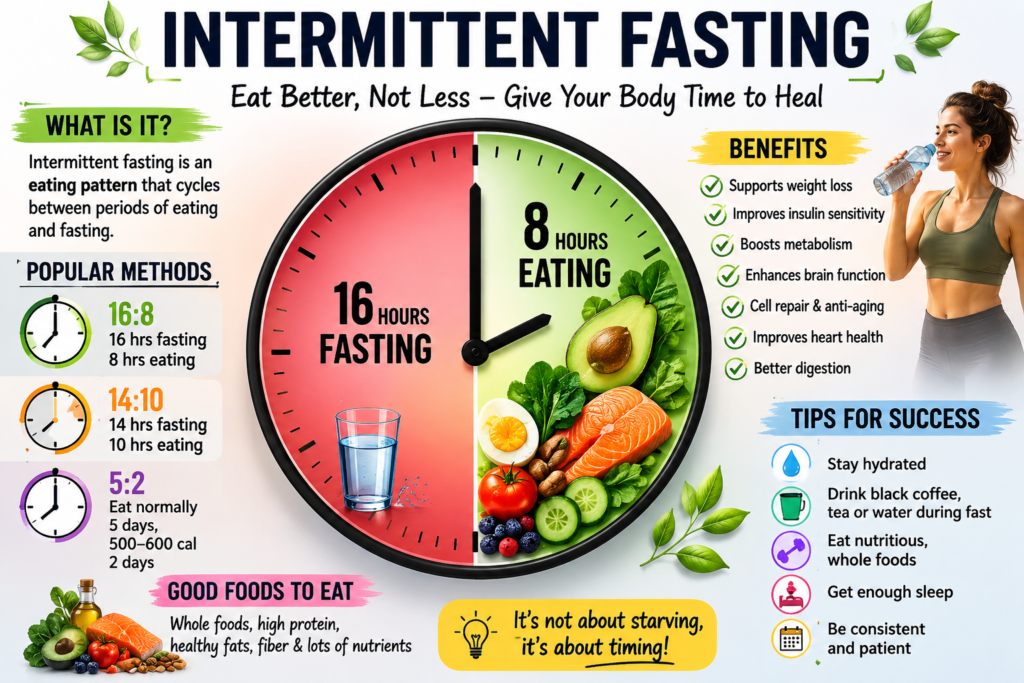
Fasting is the practice of regulating or abstaining from food and water for a specific period, either for religious reasons or health benefits. Fasting can be broadly classified into:
- Intermittent Fasting
- Time-Restricted Feeding
- Prolonged Fasting
For optimal health benefits, the 16:8 method—which involves fasting for 16 hours and eating within an 8-hour window—is highly recommended.
People have been practicing fasting for generations. However, many remain unaware of the profound physiological benefits it brings to the body. Recent scientific studies have shed light on these benefits, proving that fasting plays a vital role in maintaining overall health.
How Fasting Benefits the Body
Brain: Enhances cognitive function and mental clarity.
Lungs: Reduces symptoms of asthma.
Heart: Lowers the risk of cardiovascular diseases, reduces blood pressure, and improves the lipid profile.
Liver: Decreases glycogen storage, induces ketogenesis, and increases insulin sensitivity.
Adipose Tissue (Fat): Increases lipolysis (fat breakdown), reduces fat accumulation, and lowers inflammation.
Muscles: Increases insulin sensitivity, aids muscle preservation, improves endurance, reduces inflammation, and lowers the risk of sarcopenia (age-related muscle loss).
Gut: Reduces inflammation and promotes a healthier gut microbiome.
Systemic Benefits: Promotes weight loss, reduces overall inflammation, improves body composition, lowers the risk of cancer, increases lifespan, prevents chronic diseases, and boosts the immune system.
Autophagy and Fasting
Autophagy is the body’s natural cellular cleansing process. During this process, cells break down and remove old, damaged components like degraded proteins and worn-out organelles. When the body faces starvation or an infection, autophagy helps maintain cellular health, fights off pathogens, and ensures cellular survival.
Autophagy is essentially a ‘cellular reset‘ button, crucial for the body’s overall health and longevity.
In 2016, Yoshinori Ohsumi was awarded the Nobel Prize in Physiology or Medicine for discovering the mechanisms of autophagy. Autophagy is a vital biological defense mechanism that helps delay aging and fights off severe diseases like cancer and Alzheimer’s. Intermittent fasting acts as a powerful trigger for this process.
The Role of Insulin
Whenever we consume food, our insulin levels spike. High insulin levels put a complete halt to autophagy. On the other hand, during intermittent fasting, insulin levels drop significantly, giving cells the green light to initiate their “self-cleaning” mode.
Glucose Deprivation
When the body stops receiving external glucose, it looks inward for survival. It begins breaking down damaged proteins and cellular waste to convert them into energy. This is autophagy. However, this process does not start the moment you stop eating; it follows a precise scientific timeline.
The Biological Timeline: What Happens After You Eat
| Time Elapsed | Internal Biological Processes |
| Immediately After a Meal | Carbohydrates from food are converted into glucose, causing blood sugar levels to rise. Simultaneously, the pancreas releases insulin. Insulin ushers glucose into cells and stores the excess as glycogen in various parts of the body. |
| 2 to 3 Hours Later | Due to the action of insulin, blood sugar levels begin to drop. The body starts tapping into the stored glycogen for the energy required to function. Any excess glycogen is stored as body fat. |
| Within 9 Hours | Blood sugar levels dip further. To maintain energy, the body begins converting stored glycogen back into glucose. It is important to note that the body has still not started burning stored fat at this stage. |
| After 11 Hours | Glygocen reserves are almost entirely depleted. The body officially transitions into fat-burning mode, using stored fat as its primary source of energy. |
| After 14 Hours | The breakdown of stored fat accelerates. This metabolic shift produces organic acids called ketones, which the body begins using as premium fuel. Ketones supply highly efficient energy to vital organs like the brain and heart. |
| Beyond 24 Hours | Prolonged fasting (24 to 48 hours) exponentially increases the rate of autophagy, triggering a deep, comprehensive ‘cellular detox’ throughout the body. |
Who Should Avoid Fasting?
Fasting is not suitable for everyone. Pregnant women, breastfeeding mothers, minors, teenagers, the elderly, individuals with underlying medical conditions, underweight individuals, those engaged in extreme physical labor, and anyone prone to eating disorders should refrain from fasting. Anyone interested in starting a fasting regimen should consult a qualified nutritionist or doctor first.
The History of Food and Calories
Before the 19th century, humans typically ate only once or twice a day. The modern routine of eating three or more meals a day emerged with the Industrial Revolution as structured working hours were introduced. Laborers needed sustained energy for long shifts, which popularized the three-meal schedule. Today, breakfast, lunch, and dinner have become a rigid cultural norm, though variations still exist globally.
In terms of daily energy expenditure, a general benchmark is 2,000 to 2,500 calories for men and 1,800 to 2,200 calories for women. However, this varies significantly based on an individual’s physical activity, age, and metabolism. For instance, a sedentary person consuming 2,000 calories a day might actually be overeating.
Modern humans consume far more food than necessary. This excess energy is stored as glycogen and fat. This habit of overeating is a leading cause behind the rise of fatty liver disease, diabetes, obesity, and cardiovascular issues.
Conclusion
There was a time in human history when securing food was an everyday struggle; back then, everyone knew the true meaning of hunger. Today, the vast majority of people rarely experience actual hunger because food is constantly being consumed. We often forget that food is meant strictly for energy and survival.
Intermittent fasting is a scientifically proven lifestyle choice that can prevent and help manage a multitude of health conditions. By practicing it correctly, we can extend our lifespan and safeguard ourselves from chronic illnesses.
Ultimately, intermittent fasting is not a restrictive, unnatural diet; it is simply aligning ourselves with the body’s natural energy cycle. When done right, it serves as a powerful tool for weight management and lifelong wellness. The key is to customize the fasting window to suit your individual body type and lifestyle.