
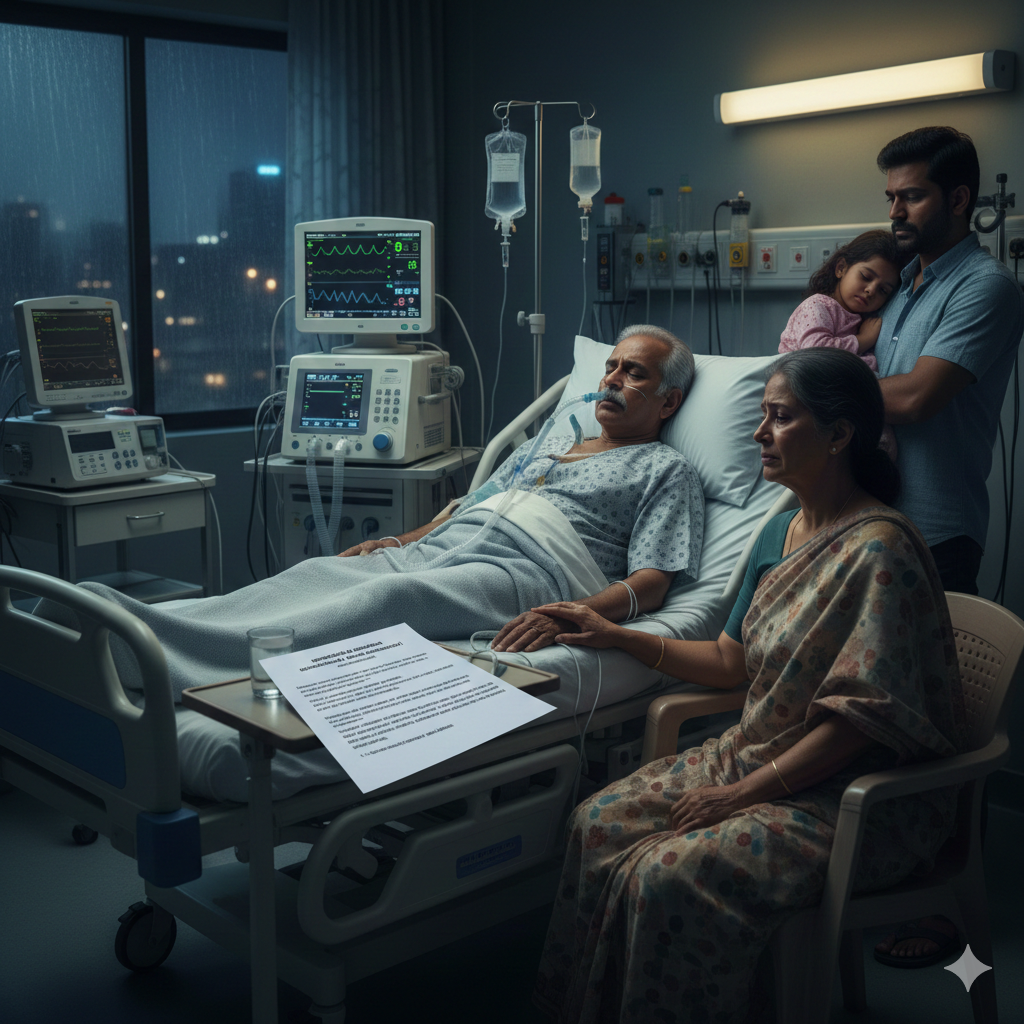
Introduction: We all spend our lives busy planning—building a home, securing our children’s education, and calculating our retirement days. But life casts its longest shadow when we least expect it. In such moments, the actions we take in the name of love often end up causing immense pain to those we cherish most. Through the story of Abhirami and her father, Raghavan, let us reflect on the profound concept of “Dignity in Death.”
A Bright Morning
Abhirami woke up at 5:00 AM to the sound of her alarm, filled with a sense of purpose. She had a major presentation at the office that day, the culmination of weeks of hard work. Her husband, Ragesh, and daughter, Rashi, were still fast asleep.
Ragesh was a blessing; despite his busy schedule in the Health Department, he always shared the household chores. That evening was also the wedding reception of Akhil, an old classmate. Abhirami looked forward to reuniting with old friends. She mentally mapped out her day: get the daughter ready, finish office tasks, take an hour’s permission at noon to buy a gift. She felt confident that everything would go smoothly.
As she watched her sleeping family, she felt a sense of completeness. She stepped into the bathroom, but suddenly, her phone began to ring incessantly.
A Bolt from the Blue
Hearing the phone ring at such an unearthly hour sent a shiver down her spine. Was it a missed call? No, it rang again. With trembling hands, she checked the screen; it was her mother.
“Daughter… Father slipped in the bathroom. His head is injured… the bleeding won’t stop. I’ve reached the Taluk hospital in Ramesh’s auto. Please come quickly…”
Her world collapsed. Ragesh woke up instantly, understanding the gravity of the situation from her voice. Without a word, he woke their daughter and started the car. Abhirami informed her brother, Abhiram, who worked in Ernakulam. The Taluk hospital was 20 kilometers away, and they reached quickly through the empty morning streets.
Conflict Amidst White Walls
At the hospital, her mother was devastated. Raghavan was unconscious. Doctors explained that the injury to the back of his head was severe and advised an immediate transfer to a Medical College or a specialty private hospital.
Using his professional contacts, Ragesh moved his father-in-law to a leading private hospital. Surgery was deemed urgent. Ragesh quietly told Abhirami the harsh truth: her father could no longer breathe without the support of a ventilator.
Abhiram arrived from Ernakulam with his friend, Robin. Robin’s father called him: “Son, don’t worry. Nothing will happen to your father. Robin will Stay with you.” Those words provided a small anchor for Abhiram.
The Dilemma of Love
That night, Ragesh insisted that Abhirami and her mother go home to rest while Abhiram and Robin stayed back. It was then that Abhiram spoke to Robin about a video call they had the previous night.
“Robin, Dad was so happy yesterday. We were discussing my wedding. He said he wanted to see my child before he closed his eyes. But he also said something he had mentioned before: ‘If anything happens to me, don’t chain me to machines. I don’t want to die like that.’ He had seen relatives suffer on ventilators—tubes through the mouth and nose, unable to express their pain. He was terrified of that state.”
Robin nodded. But the reality was different. When faced with the choice between a loved one’s wish and their life, love almost always chooses life at any cost.
A Chaos and a Revelation
The next morning, a commotion broke out in the hospital. A young man was shouting at the doctors, “You all killed my mother!” His mother had been on a ventilator for ten days. Every day they were told she was “improving,” but when she passed away, the son couldn’t take it. Allegations that hospitals keep patients on ventilators just for money filled the air.
This incident instilled fear in Abhirami and her mother. They approached the doctor with similar doubts. The doctor’s reply was calm but stark: “The patient’s condition is critical. The body isn’t responding to medicine. Only this machine is keeping him alive. You can transfer him to the Medical College if you wish, but anything that happens during the transit will be your responsibility.”
Ragesh remained silent. He had the ‘Living Will’ (Advance Medical Directive) that Raghavan had prepared, stating clearly that he did not want ventilator support. But Ragesh feared that if he produced it now, the family would hate him. He feared being labeled “the one who let his father-in-law die.” Love often forces us to hide the truth.
The Final Journey
Days passed. Raghavan lay amongst the machines, unresponsive. Finally, the moment came. Doctors confirmed his passing.
Back home, the mother broke down. “He always told me, don’t put me on those machines.’ I couldn’t keep that promise. In the name of love, I only gave him more pain…”
Her mother’s cries broke Abhirami’s heart. Tears filled Ragesh’s eyes. Why did they prolong his suffering for so long? Why didn’t they honor his final wish?
Conclusion: The Greatest Love of All
In this story, Raghavan did not get the death he desired because our society still hesitates to talk about “Dignity in Death.” When doctors confirm that a person cannot recover, we must be brave enough to reduce the terminal pain they endure. Love is not just about holding on; it is also about letting go the way they wished.
No one can escape the truth of death. Is it right to chain a loved one to machines when there is no hope? This is not about denying treatment; it is about allowing a dignified exit when life cannot be restored. We must act not to satisfy society’s expectations, but to minimize our loved one’s agony.
The Indian legal system now recognizes the ‘Living Will’. The greatest love we can show our dear ones is to respect their wishes at the very end.
What is a Living Will?
It is a legal document prepared by an individual while they are of sound mind. it specifies that if they ever reach an irreversible state of illness or unconsciousness, they do not wish to be kept alive by artificial life-support systems (like ventilators).
Living Will Template: Advance Medical Directive
I, [Name], son/daughter/wife of [Parent/Husband’s Name], residing at [Full Address], being of sound mind and acting of my own free will, do hereby declare:
- If I reach a permanent and incurable medical condition where I can no longer make my own decisions, I do not wish to receive life-sustaining treatments like ventilators, CPR, or dialysis.
- I request only Palliative Care to alleviate my pain and provide comfort.
- This directive is binding upon my family members, doctors, and the hospital.
- I reserve the right to revoke or change this directive at any time while I am of sound mind.
Place: Date: Signature: Witnesses: (Two Required) (Note: It is advisable to have this attested by a Notary or a Gazetted Officer for legal strength.)
Does this story make you think? Have you ever discussed these choices with your loved ones? Share your thoughts in the comments below.