
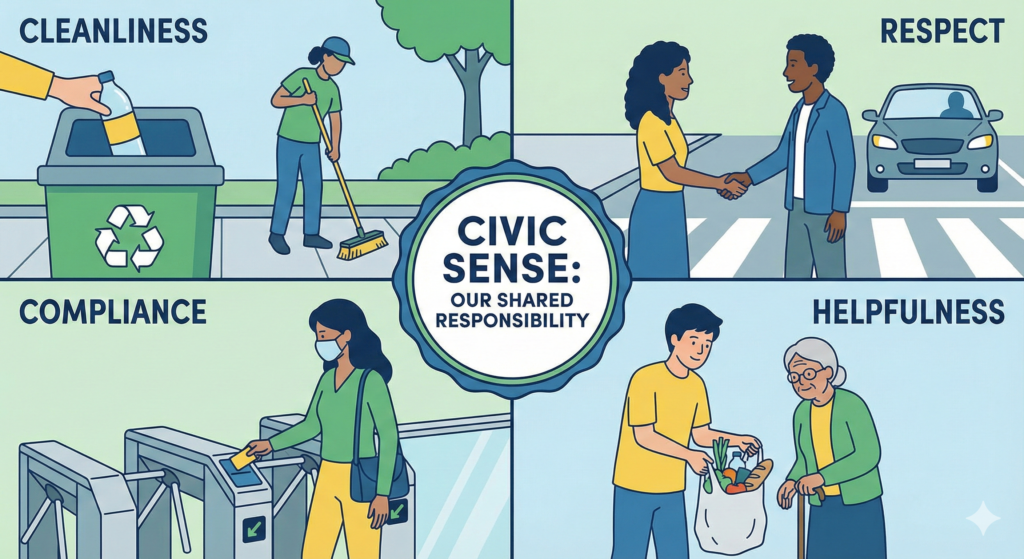
Every individual is part of a community, which necessitates adherence to fundamental values and conduct. This concept is known as Civic Awareness (or Pourabodham). Civic awareness reflects the ethics of a contemporary community. Humans are inherently social beings; no one can thrive or meet all their needs in isolation without support from others.
When we venture beyond our front doors, everything we encounter belongs to the collective. For example, public transport, roadways, healthcare facilities, workplaces, and landmarks are communal assets, not personal possessions. It’s not about using these resources at will; we must recognize that others share them, and our actions should not cause inconvenience. It is important to remember that paying taxes does not grant us the exclusive right to misuse public property.
Each citizen in India holds pride in their nationality and the fact that India boasts one of the world’s most vibrant cultures. However, do all Indians genuinely fulfill their civic duties? The absence of civic sense mainly stems from ignorance and, in some instances, intentional misconduct. Presently, no nation exhibits perfect civic awareness, but countries like Norway, Switzerland, Denmark, and Sweden stand out as exemplars. In Asia, Japan and Singapore are the foremost leaders in civic responsibility. Within India, states like Kerala, Tamil Nadu, Sikkim, and Mizoram are recognized for their elevated civic consciousness. The level of civic responsibility is unique to each person, which is why no country achieves absolute perfection in this area.
An individual with civic awareness embodies a commendable human being who respects and safeguards both their well-being and the community, ensuring they don’t inconvenience others. It is not guaranteed that a well-educated person will possess civic sense; their upbringing, character, and mindset are influential factors. While laws can promote civic awareness to some degree, true cultivation requires a foundation of internal understanding. This understanding should commence at home, persist through education, and be exemplified in daily life, thereby inspiring others.
Much of what we perceive as “normal” behavior is often misguided. Let’s scrutinize these bad habits:
- Spitting, urinating, and littering in communal spaces.
- Cutting in line at hospitals, ticket booths, and other venues.
- Smoking, using intoxicants, and spitting in shared environments.
- Speaking loudly on the phone, singing, or playing audio at a volume that disrupts others in public transport and spaces.
- Trespassing onto others’ property or taking fruits/items without consent.
- Writing, drawing, or putting up advertisements in classrooms, public areas, or restricted zones.
- Traffic Violations: Recklessly driving at high speeds, blocking other vehicles, crossing streets carelessly, using a phone while driving, parking improperly, running red lights, driving on sidewalks, honking excessively, neglecting to use low beams at night, obstructing ambulances, driving the wrong way, or braking abruptly.
- Vandalizing or dirtying public restrooms.
Conclusion
Civic awareness is evolving alongside educational advancements and legal frameworks. However, civic education should initiate at home, where parents serve as the earliest and most significant teachers. It is their duty to instill in children the principles of social living and conduct. Later, this should be reinforced in schools. The government should spearhead efforts to enhance civic awareness, while media outlets, social platforms, public figures, and role models should advocate for the importance of civic responsibility.
The preservation of public spaces is not solely a government obligation; it rests on every one of us. While every individual enjoys the freedom to live in India, it is crucial not to infringe upon the rights of others. We all aspire to lead fulfilling lives, which is only achievable when we contribute to a harmonious existence for all.