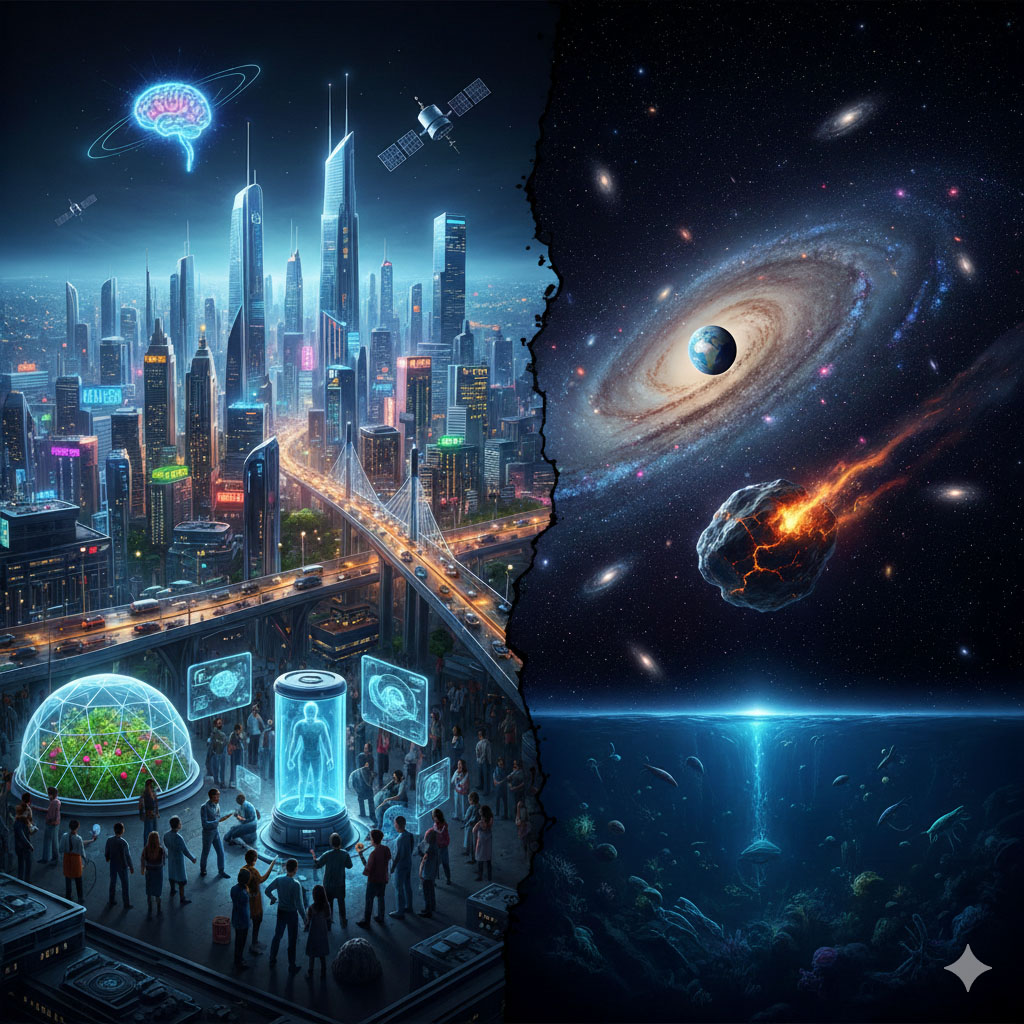
Throughout history, humans have harbored the deep-seated belief that we are the center of the universe. We have viewed ourselves as the pinnacle of creation, with all other living beings relegated to a lower status—often existing merely for our consumption or utility. This sense of “human exceptionalism” has been fueled by our unique intelligence and our ability to craft tools. Our capacity to manipulate nature and extract its resources has only reinforced our self-appointed status as the sovereign rulers of Earth.
The Illusion of Control in the Modern Era
In the modern age, science and technology have granted us unprecedented power. We can now predict natural disasters, map the human genome, and even alter the genetic blueprints of living organisms. This prowess has fostered a certain collective arrogance. We are currently obsessed with conquering the final frontier: death itself. Research into longevity is booming, and several companies now offer “cryopreservation,” freezing bodies in the hope that future breakthroughs might one day restore them to life.
However, no matter how advanced our laboratories become, death remains an inescapable reality. We might learn to postpone it or improve the quality of aging, but we cannot outrun it forever. Science ultimately reveals a humbling truth: in the vast expanse of the cosmos, humanity is but a tiny, transient speck. We often think we are greater than nature, but the reality is that we cannot survive without it, while nature has no inherent need for us. If humanity were to vanish tomorrow, the Earth would likely heal and flourish. Among all species, humans are the only ones who systematically exploit the planet to its breaking point.
A Perspective from Modern Astronomy
Modern astronomy offers the most sobering reality check. Our Earth is a mere pale blue dot—a small planet orbiting an ordinary star in the suburbs of the Milky Way galaxy. Our galaxy itself is just one among trillions in the observable universe. While the mathematical probability suggests that life exists elsewhere, the sheer scale of the universe prevents us from finding it.
Consider the speed of light: it travels at approximately 300,000 kilometers per second. Yet, even at this cosmic speed limit, the distances are staggering:
- To leave our solar system (the Oort Cloud), it would take about 1.87 years at light speed.
- To reach Proxima Centauri, our closest neighboring star, it would take 4.24 years.
- To exit our own Milky Way galaxy, you would need to travel for 100,000 years.
- Reaching the center of our galaxy would take between 25,000 and 27,000 years.
When we compare these numbers to the average human lifespan, our “supremacy” begins to look like a delusion.
The Mysteries Within Our Own Borders
Even on our own planet, we are far from all-knowing. While 71% of Earth is covered by water, we have explored only about 5% to 20% of our oceans. Nearly 80% of the underwater world remains a mystery. Vast stretches of Antarctica and the deep Amazon rainforest are still terra incognita.
While it is true that human life expectancy has reached 70+ years today—a significant jump from the pre-20th-century average of under 50—this progress is fragile. This increase is largely due to modern medicine, clean water, vaccinations, and better sanitation. We have conquered many infectious diseases and reduced infant mortality. Yet, we now face a new wave of “civilization diseases”: heart disease, cancer, diabetes, and a global crisis in mental health, including depression and anxiety.
The Human Paradox: Progress Without Peace
Despite our technological evolution, we have failed to solve the most basic human problems. Millions still lack food, clothing, and shelter. We claim to be the “perfect” species, yet we are plagued by illness and internal strife. Perhaps the greatest tragedy of the modern era is that man has become his own worst enemy.
We are defined by our complex brains, but that very organ is incredibly delicate. A mere two days without sleep can cause a total breakdown in cognitive function. We are biologically dependent on air, water, and food, yet we prioritize reaching other planets while ignoring the declining population health and systemic inequality on our own. We build wonders for “humanity,” yet a vast portion of the population never sees the benefits. We remain a species divided by artificial boundaries.
The Final Reckoning
The universe is approximately 13.79 billion years old. Earth formed 4.54 billion years ago. Modern Homo sapiens appeared only about 300,000 years ago. Scientifically speaking, we are just a recent byproduct of biological evolution.
History is a graveyard of those who believed they could conquer the world. The truth is, we are mere guests on this planet—and very short-term guests at that. Our technology is impressive, but it is no match for the fundamental forces of nature. A slight shift in the Earth’s crust or a single asteroid—like the one that wiped out the dinosaurs—could erase our entire civilization in a heartbeat.
True wisdom lies in recognizing our insignificance. Only by acknowledging that we are part of nature, rather than its master, can we hope to survive the blink of an eye that is our time in the universe.